Overpay or ‘perfect site’? County to open its most expensive homeless shelter
Sacramento County is doubling down on its strategy of large homeless shelters: Construction of the capital region’s largest and most expensive shelter to date is currently underway.
The North Highlands site, when it opens early next year, will shelter up to 275 people in sleeping cabins and in their vehicles, and provide weather respite for 75. The county paid about $64 million total to stand it up, including about $42 million to construction companies to turn the former office building and parking lot into a shelter. It also spent $22.8 million to buy a vacant warehouse, which had sold for just over half that amount just a year before the county bought it.
The 13-acre property, at 4837 Watt Ave., sold for $12.45 million to Pennsylvania-based global real estate firm EQT Exeter in September 2021, according to county records. Exeter put about $1 million of renovations into the property, according to a 2022 independent appraisal the county got.
The appraisal determined the value of the property — including a 130,000 square foot warehouse and a 9-acre parking lot — was $16.9 million. County staff submitted an offer to purchase it for $15 million, according to emails The Sacramento Bee obtained from a California Public Records Act Request. Exeter countered with $22.8 million. Staff brought it to the Board of Supervisors, recommending approval. All but $1.9 million of the purchase was to be funded by federal American Rescue Plan Act funds, intended to help with the COVID-19 pandemic.
“The negotiated price, although higher than the appraised value, is comparable to recent sales of similarly sized industrial properties,” the October 2022 county staff report said. “In addition to the site’s size and proximity to existing unsanctioned encampments, the property is favored as a prospective Safe Stay Community because it can include sleeping cabins indoors, and has space for safe parking in vehicles outdoors.”
The staff report cites the need to find a warehouse to place sleeping cabins indoors; that was, staff wrote, one of the reasons the building on Watt Avenue was “favored.”
After buying it, the county contracted with an architecture firm, that determined it would cost too much to retrofit the building to place the cabins inside, said Janna Haynes, a county spokesperson. Staff recommended they instead be placed outdoors, with the Board of Supervisors approving the change in August 2024.
Obtained emails show some other reasons that bumped up the purchase price.
“The pricing they countered in reflects their initial projections of leasing the asset and selling as part of a portfolio, typically combined with other assets in various markets to help boost pricing,” Ali Nadimi, an outside realtor on the deal, wrote to county staff.
“What also was taken into account by the Seller is the overall land value as the site is 13 acres and has potential to add another 110,000 (square foot) warehouse. I believe our initial price offered triggered Seller to provide a number they’d sell at, but not their best priced counter. Not to mention, they have received multiple full building offers recently that has also been taken into consideration in their counter.”
When the supervisors discussed the topic in October 2022, they heaped praise on staff for the deal.
“I think this is kind of a watershed moment for the county to be investing in a project of this nature, of this size,” said Supervisor Rich Desmond.
“I don’t know how you found such a perfect site,” said then-Supervisor Sue Frost. “Not only found it but went after it. It wasn’t for sale.”
The supervisors approved the purchase, which closed Nov. 30, 2022.
In the end, Exeter sold the property in 2022 for over $10 million more than it bought it for 14 months earlier, despite putting only $1 million of improvements in.
County officials expect at least 18,000 people to spend time at the shelter over the course of 15 years, which works out to about $3,600 per person for the $64 million the shelter cost, according to a county document.
But it may prove difficult to move people into permanent housing from the shelter. During the first nine months of the 175-bed, Stockton Boulevard shelter, which the state paid to build, 11 guests moved into permanent housing.
The city and county of Sacramento have spent $120 million of local, state and federal funding in the last five years to stand up and operate eight large shelters, a Bee investigation found.
‘Dumbstruck at the price tag’
The public has noticed the shelter’s $64 million price tag.
“First and foremost, congratulations on the progress you’re helping attain by providing shelter and services for the most vulnerable in our community,” said Sacramento resident Steve Hoover in a July 31, 2024, email to Supervisor Rich Desmond. “I must confess to being dumbstruck at the price tag … I realize that this effort is a ‘done deal,’ but in the future, maybe other alternatives could be looked at that are less expensive?? For example, it has been reported that Denver, Colorado has had remarkable success by providing a $1,000 per month stipend for vetted homeless people.”
Desmond’s staff forwarded the email to another county staff person who said she would provide the elected official with “talking points related to these costs and the benefits of the project.”
Asked why the county is moving forward with large costly shelters despite their low rate of guests being permanently housed, the county’s homeless services director Emily Halcon said the Board of Supervisors wants more shelters.
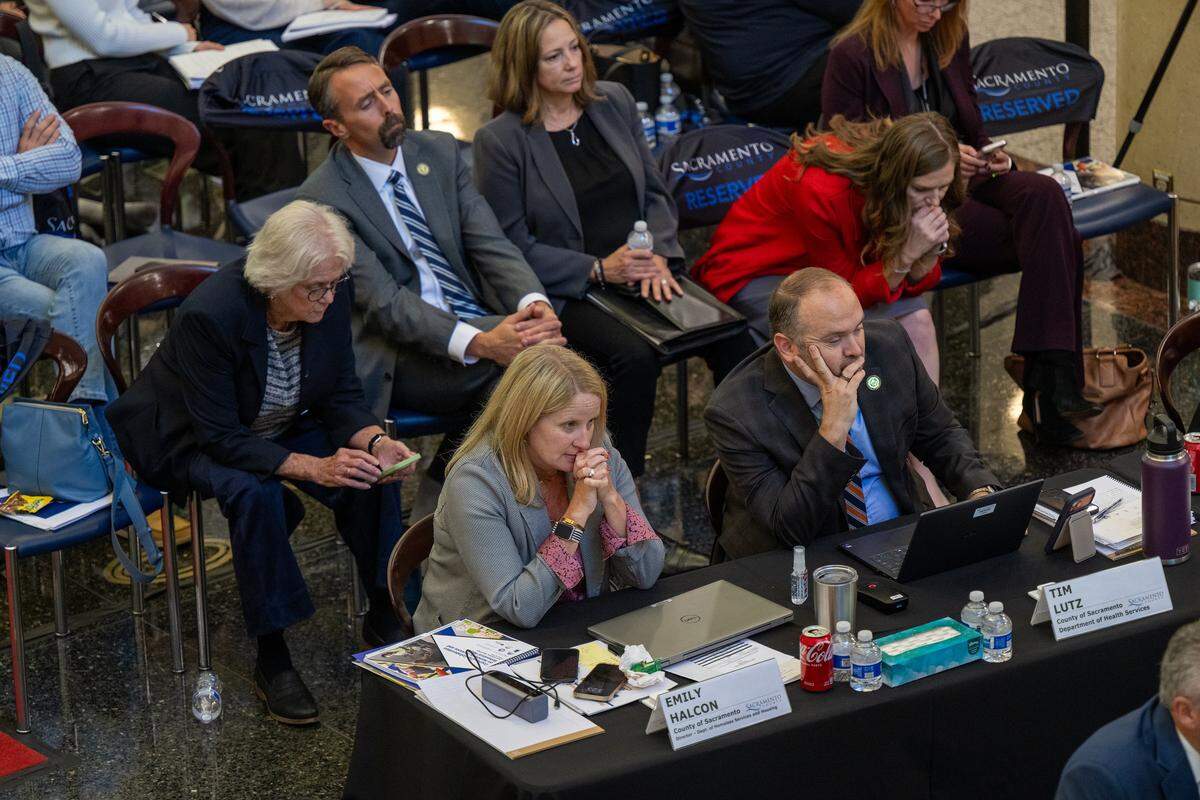
“We have a big crisis of unsheltered homelessness, and there’s a community call for safe spaces for people to go, and I think the board responded,” Halcon said. “The (state funding we’ve gotten under Gov. Gavin Newsom) lets us do that at a scale that we have never been able to.”
Experts across the state have also pointed to rent subsidies, even as low as $300 a month, as more successful than shelters. One possible reason for elected officials continue to double down on shelters is that rental assistance and subsidy programs suffer from a lack of visibility.
New tiny home shelters make for a better photo op for politicians than rental checks, said Emily Potts, an associate professor of architecture at Sacramento State.
City and county officials in January held a press conference to announce the opening of the Stockton shelter — the first location to fulfill Newsom’s promise from a year prior to open tiny home shelters across the state.
“There is a real strong desire to do something and putting the tiny homes up is a visible, tangible thing,” said Potts, whose class toured the Stockton Boulevard shelter earlier this year. “You don’t see the rent assistance the same way. But economically that’s probably the better choice.”