
Restraining order renewed because of alleged online doxxing in California NAACP case

AI-generated summary reviewed by our newsroom.
- Court renews restraining order through Jan. 6 in NAACP doxxing case
- Allegations posted online about NAACP official are unsubstantiated
- Concerns arise that the efforts are backlash from reporting alleged corruption
A Santa Clara Superior Court judge has extended a restraining order until a new hearing Jan. 6 in a case involving allegations of electronic cyber harassment — or doxxing — connected to a recent vote for leadership of the NAACP in California.
Judge Johanna Thai Van Dat’s Tuesday ruling maintains the filing by Rick Callender, the regional president for the NAACP for California and Hawaii who was re-elected in October. Callender helped expose an alleged corruption scheme involving a COVID-era food initiative connected to the local chapter of the NAACP and was targeted, while he was running for the office, by online messaging and a video which claimed, without evidence, that he had serially sexually abused women.
An emergency restraining order filed by Callender was granted in October against Basil Kimbrew, an L.A.-based political consultant who the Los Angeles Times once called a self-described “political provocateur.”
Kimbrew has been convicted of felonies for financial impropriety as a Compton school board member and for charges related to state election code violations. He has said his past issues were connected to addiction, and largely has steered clear of controversy, reinventing himself as “Chef Basil.”
Kimbrew’s recent election activism also led to his suspension from the NAACP. In an Oct. 6, 2025 letter to Kimbrew, national NAACP President Derrick Johnson said: “The NAACP hereby immediately suspends your membership for the following reasons. On September 30, 2025, you distributed a mass email urging California NAACP members to ‘PLEASE HELP US TO STOP THIS HIDEOUS BULLY, CA NAACP PRESIDENT RICK CALLENDAR.’ Your flyer included President Callender’s home address and cellphone thereby jeopardizing his safety and his family’s safety.”
Callender’s connection to Sacramento
Callender played a key role exposing alleged corruption in a Sacramento County $2.75 million COVID food aid contract that was spearheaded by Betty Williams, the former president of the Sacramento branch. Williams was suspended by the NAACP for financial impropriety and is currently under investigation by the Sacramento County District Attorney.
Callender tried to alert Sacramento County supervisor Pat Hume about the Dine-In 2 food program, expressing concerns in January 2024 about the role of the county official overseeing it.

“Stephanie Hopkins’s personal company was involved with the program somehow,” Callender wrote. In his email, Callender encouraged the county to investigate.
“Ms. Hopkins was in the lead,” he wrote. “I do hope that there is not any situation of public corruption vs lackluster oversight.”
A Sacramento Bee investigation detailed how Hopkins allegedly oversaw the program while profiting from it. Hopkins, a program planner with the county’s Department of Human Assistance, allegedly profited from the food program while approving invoices for it. She also participated in an audit that concluded the program she oversaw improperly allocated federal funds and that the county should demand they be refunded.
Williams, a longtime Sacramento political figure and activist, was ousted from her position and several other members have been suspended for either financial or other misconduct. A Sacramento County audit and an internal NAACP investigation found that Williams and two other former Sacramento NAACP officials violated conflict of interest regulations and paid themselves hundreds of thousands of dollars through the county contract.
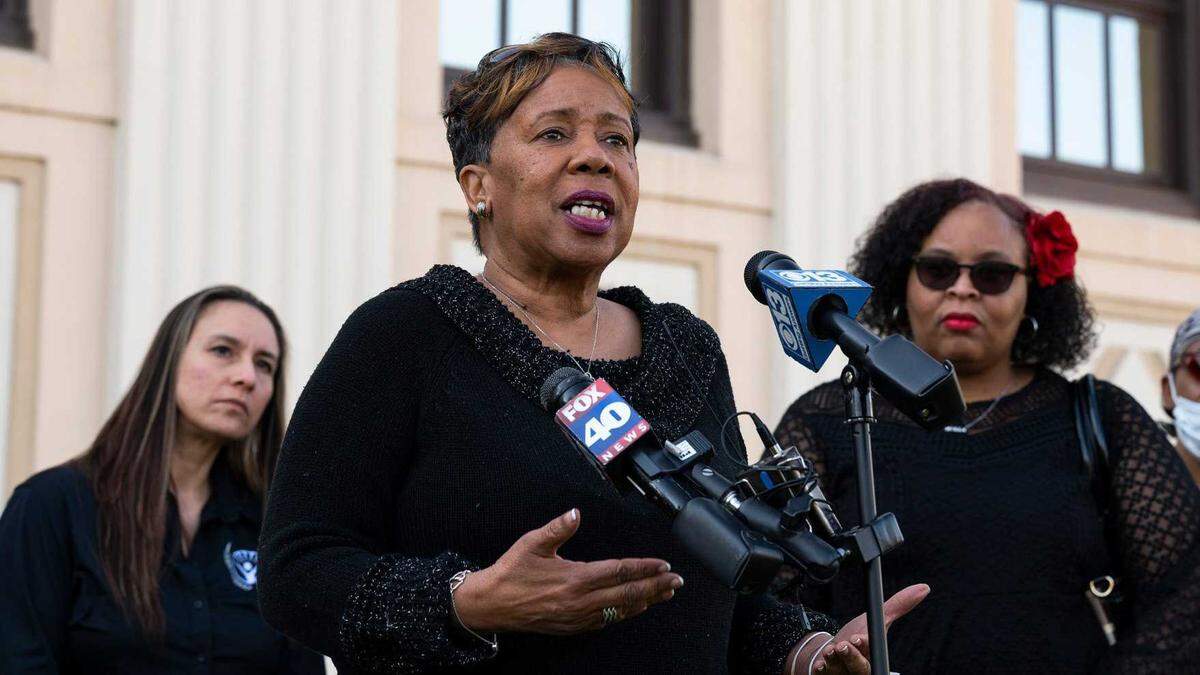
Williams created a non-profit, the National African American Civil Rights Organization, or NAACRO, in January 2025.
Behind the election
NAACRO’s vice president, Paullete Gipson, the current president of the Compton NAACP, challenged Callender in the October election.
Callender ultimately prevailed by a 5-1 margin, but not before several members of NAACRO circulated the video about Callender. In the video, that resulted in the restraining order, a woman is seen making a T-shirt that states “Safe from being sexually harassed by the NAACP’s Rick Callender.”
Reached by phone, Kimbrew said he hadn’t been served in the restraining order case and only recently learned about it.
He did not say whether he would attend the Jan. 6 court hearing in San Jose. He also would not comment about whether he had coordinated his efforts with NAACRO, referring additional questions to Gipson, providing her number in a text.
The video was created by a social media personality “Advocate Anne.” Advocate Anne is also linked to Lourrie Walker who, according to NAACRO’s incorporation papers is an officer in the non-profit whose title is “Director of Research and Development. Advocate Anne’s Etsy website markets the accusatory T- shirt for $27.60.
Walker was suspended as president of the Antelope Valley NAACP in February 2025. In a phone interview she did not deny making the video or marketing the T-shirt, stating that “actually quite a few of us use that Advocate Anne account.”
Walker defended her activism against the national NAACP, claiming the organization does not represent ordinary African Americans.
“They are so corrupt, they covered up a man choking a woman out at a national convention,” she said.
The national NAACP did not respond to a request for a comment from The Bee. But one senior official said they were troubled by the video and the emergence of NAACRO.
“How can you trust an organization led by Betty Wiilliams?” said the official, who did not wish to be identified because they were not authorized to speak on the matter. “The financial impropriety that occurred in Sacramento was sad and disheartening.”
“As California NAACP president, Rick has a fiduciary responsibility to bring these issues to light,” the official said. “These rumors being spread about President Callender are not true, and clearly designed to intimidate anyone who speaks out against corruption.”
The court order states Kimbrew must be successfully served five days before the hearing. If Kimbrew is not served prior to the Jan. 6 court date, the judge has the option to extend the restraining order and allow Kimbrew to be served by mail for a subsequent hearing.