Predicting the future via California redistricting
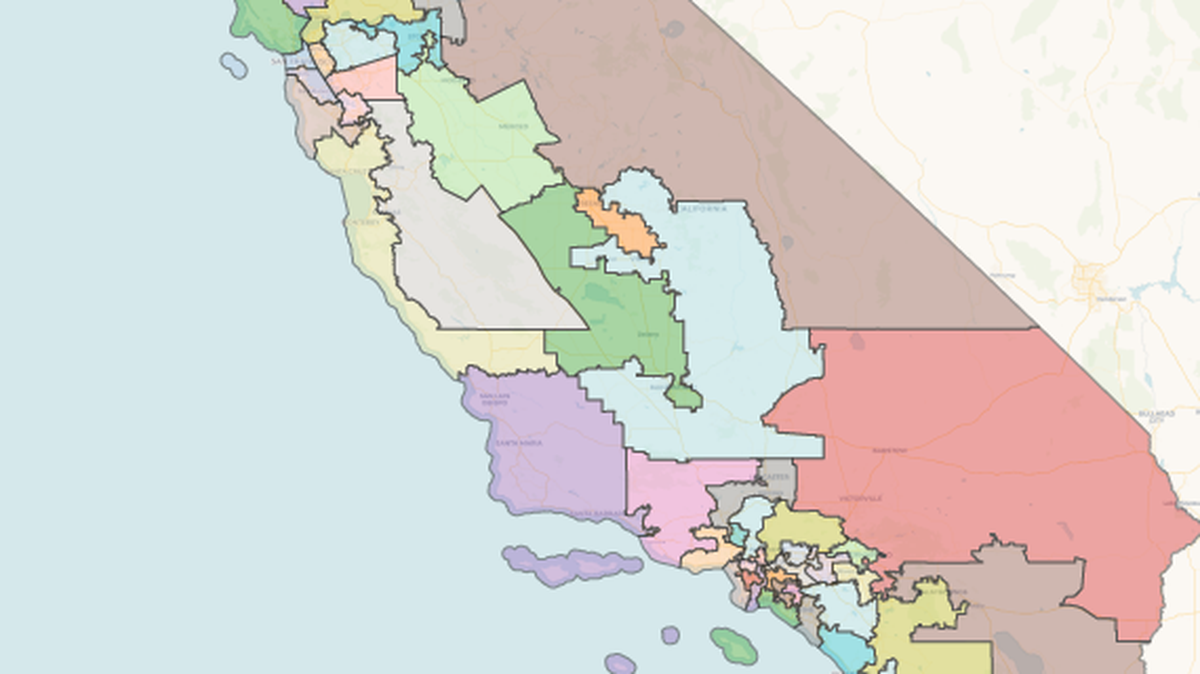
LOOKING INTO THE REDISTRICTING CRYSTAL BALL
Via David Lightman...
Three Republicans targeted by Democrats in their redistricting maps – Reps. Kevin Kiley, Doug LaMalfa and Ken Calvert – will find themselves underdogs in their new districts. But two other Republicans, Reps. David Valadao and Darrell Issa, would be running in races rated tossups.
Those are the early analyses of what would happen in California if Gov. Gavin Newsom’s proposed redistricting plan is approved by the Legislature this week and by voters in November.
Sabato’s Crystal Ball, a nonpartisan organization at the University of Virginia that studies House races, found that “the endgame of this redistricting battle is still very uncertain. One way of looking at it is that if California Democrats succeed, Republicans may still come out of the overall redistricting fight ahead, but probably not by a lot.”
But, it said, “if this proposal is not enacted, Republicans may come out substantially ahead after the dust has settled.”
Republicans now hold nine of the state’s 52 House seats. Democrats need a net gain of three seats nationwide to win control of the House. Texas is redrawing its maps with the goal of creating at least five more GOP-friendly districts. Newsom’s goal is to counter any such gains.
In California, the Crystal Ball made these assessments:
– Kiley: The Roseville Republican won by 11 percentage points in 2024. President Donald Trump won his district by 4, but had the new lines been in place, Democratic nominee Kamala Harris would have won by 10. Under the new maps, the analysis said it would become a “likely Democratic’’ district and maybe even safe Democratic.
– LaMalfa: The Chico Republican is currently in what is regarded as a safe northern California GOP seat, but would add very Democratic turf in the Santa Rosa district. That would also make it a likely and maybe safe Democratic seat.
– Calvert: The Riverside County Republican’s district is “virtually eliminated,” the Crystal Ball said. It would become a majority Latino Los Angeles area seat, making it a potentially solid Democratic pickup.
– Issa.: The San Diego area veteran would add Palm Springs, which trends Democratic, creating a district that would have backed Harris by 3. “We would probably call this seat a toss-up if the map became operative,” the analysis says.
– Valadao: The Hanford Republican has been up and down in his years of running, but won easily last time in a district Trump carried by 6. The map would have narrowed that gap to 2.
“We currently rate this district as Leans Republican — it would probably move to toss-up if this map goes into effect, but this probably would still be the hardest district for Democrats to pick up of the five possible gains they’ve drawn for themselves in this proposal,” the analysis says.
There are some incumbent Democrats who could face a tougher time, “but they don’t seem like plausible Republican targets in 2026,” the analysis said.
It mentioned Rep. Ami Bera, D-Sacramento, who would pick up some of Kiley’s Sacramento area turf. Bera is weighing whether to challenge Kiley in a redrawn setting.
BONTA SUES TO BLOCK CONDITIONING CRIME VICTIMS’ FUNDS
California Attorney General Rob Bonta and his counterparts in New Jersey, Rhode Island, Delaware and Illinois are suing to stop the U.S. Department of Justice from withholding grant funding for crime victims to states that don’t comply with the White House’s immigration enforcement agenda.
On Monday, the group of 21 states filed a complaint in Rhode Island after receiving notices last month that they would not be awarded any Victims of Crime Act grants from the DOJ’s Office for Victims of Crime if they do not collaborate, comply with, or give “unfettered access” to Department of Homeland Security agents carrying out immigration investigations. All of those states have had laws that predate the Trump administration limiting their ability to assist federal immigration officials targeting people for deportation.
The window to apply for new OVC funding starts Wednesday, according to the complaint. The OVC, which began during the Reagan administration, allocates grants to pay for witness coordinators, victim compensation, crime scene cleanup, counseling, forensic exams and other services. California is set to receive $165 million this year, according to Bonta’s office.
Bonta said the president was holding the grant funds “hostage” in a statement announcing his 38th lawsuit against the federal administration in the 30 weeks since Trump took office.
“This brazen attempt to use funding that supports our most vulnerable residents to strong-arm California and states nationwide into doing the federal government’s job for it, is blatantly beyond the power of the President,” Bonta said. “We’ll see him in court.”
The same day, the White House published a statement blaming California’s sanctuary laws after an Indian truck driver made a “reckless” U-turn on the Florida Turnpike, killing three people. Authorities said the trucker, Harjinder Singh, had entered California from Mexico illegally in 2018 before obtaining his commercial drivers’ license there.
CAP-AND-TRADE WITH AN EYE ON AFFORDABILITY
The Legislature’s bipartisan Problem Solvers’ Caucus wants to make sure affordability is top of mind as Gov. Gavin Newsom presses lawmakers to reauthorize the cap-and-trade program through 2045.
On Monday, the wonky group — made up of 13 Democrats and 13 Republicans that regularly meet to discuss top issues — said it wanted to see oversight and cost analyses baked in. Members want their fellow lawmakers to consider keeping free allowances and offset protocols to ease pressures on food, gas, utilities, building materials and others and keep businesses and jobs in state.
They also want the Legislature to visit old rules to ensure they aren’t driving up costs by burdening firms with having to comply with outdated regulations: “Prior rules may become irrelevant, need updates, or contain legacy costs that exceed current benefits.”
“We can do Cap and Trade and accomplish our climate goals in a way that attracts other governments to match our policies, but it must be cost effective,” said co-chair Assemblymember David Alvarez, D-San Diego. “California’s climate policies should prioritize affordability and market principles while addressing environmental concerns,” said co-chair Sen. Suzette Martinez Valladares, R-Santa Clarita.
“A well-structured Cap-and-Trade program can drive innovation more cost-effectively than heavy mandates, but it must consider costs, jobs, and competitiveness while ensuring rigorous oversight and stable rules that encourage long-term investment.”
QUOTE OF THE DAY
“We have had enough of this nonsense.”
—Assembly Speaker Robert Rivas, D-Hollister, during an announcement of California Democrats’ plan to counter Texas redistricting.
Best of The Bee
- Redistricting could reshape CA’s House maps. See if your district would change, via Daniel Hunt
- Mortgage lender settles California case for $2.3 million in fines and refunds, via Sharon Bernstein
- Comedian and ‘Tires’ star Shane Gillis bringing tour to Sacramento. Here’s when, via Marcus D. Smith
This story was originally published August 19, 2025 at 4:55 AM with the headline "Predicting the future via California redistricting."