Could a ‘miracle’ March make up for California’s bone-dry February? What history tells us
Do you believe in miracles?
At this point, it would take one to restore water and snowpack totals in a very dry California near average levels for the winter.
Devoid of any meaningful rain since Jan. 26, Northern California has been barren for almost a month. The short-term weather forecasts will tell you there’s no relief in sight: Even with an extra day on the calendar due to leap year, Sacramento looks all but certain to have its first ever completely rain-free February in recorded history, a span of more than 170 years.
The capital city isn’t alone. Fresno, Merced, Modesto, Stockton and Redding have also had 0.00 inches this month, and essentially all of Northern California is well below average in terms of precipitation.
As of Wednesday, snowpack levels across the Sierra Nevada range stood at just 52 percent of normal for the date, according to the Department of Water Resources. That’s despite a January that saw feet of snow fall in the Tahoe area, to skiers and snowboarders’ delight.
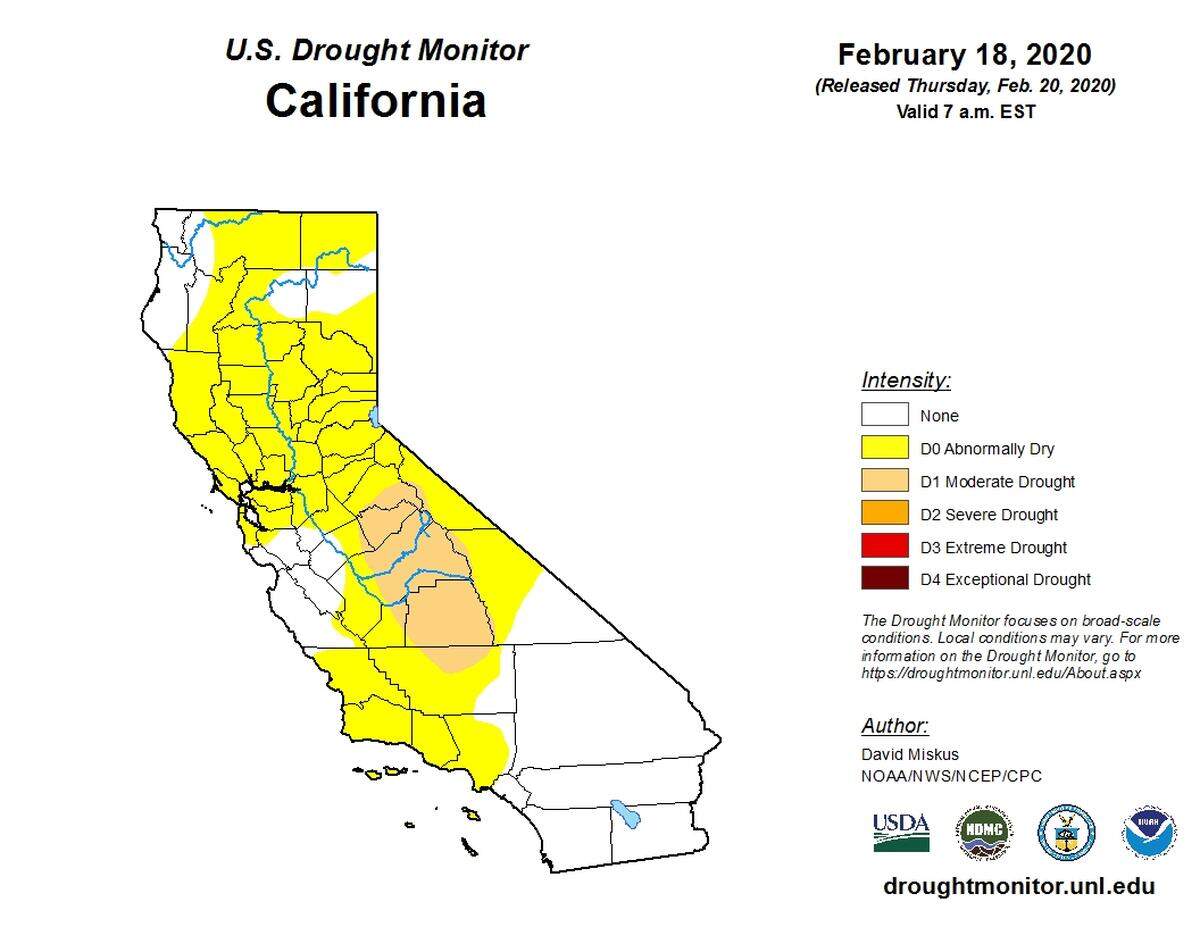
Meanwhile, the most recent map by the U.S. Drought Monitor, released Thursday by a consortium of federal agencies, now shows 60 percent of California’s land area at either “abnormally dry” (about half the state) or “moderate drought” (about 10 percent) levels, about 14 percent worse than the previous week.
What would it take to get California back on track before the end of what’s normally the rainy season? A lot — and don’t get your hopes up.
First, a bit of history.
What was California’s ‘March miracle?’
Sometimes flip-flopped and written as the “miracle March,” either term refers to the month of heavy-duty storms in 1991 that boosted the state from a miserable start to that winter.
Entering March 1991, California was in one of its direst positions of the 20th century from a water health standpoint, five years into what ended up being a six-year drought. Sierra snowpack March 1 of that year was recorded at about 18 percent of the historic average, according to various archived news stories.
But then, the miracle came. A blizzard hammered Lake Tahoe-area ski resorts with over 4 feet of fresh powder through the first three days of the month, as the Tahoe Daily Tribune reported in a 2008 retrospective.
By March 25, a near-nonstop flurry of snowstorms had upped the Sierra snow-water equivalent from 18 percent to 74 percent of normal, a shocking (daresay miraculous?) boost over a span of less than four weeks.
Rain hit the valley hard, too. Sacramento, which has gotten on average about 2½ inches of rain in March going back to 1941, more than doubled that figure with 6.14 inches.
It wasn’t all peachy.
Archived stories published by The Bee on March 26 and March 27, 1991, highlighted the danger. In the course of a few days, the Lake Tahoe area saw avalanche warnings; creeks flooded near neighborhoods in Roseville, Rio Linda and Citrus Heights, threatening homes; thousands in the foothills lost power; funnel clouds were spotted in the Central Valley; and the California Highway Patrol reported the death of a 72-year-old man, impaled by a wind-whipped tree branch while driving on Highway 88.
Has anything like that happened since?
In short, not quite.
Less than a year after then-Gov. Jerry Brown declared the most recent drought officially over in 2017, California had another miserably dry start to 2018.
Sacramento got a healthy 5.2 inches of rain that January, but it was followed a meager 0.6 inches in February 2018, which represented the second-lowest total for the month since 1995.
Fears of another drought loomed. But then, a trio of atmospheric river systems graced Northern California with much-needed rain and snow, helping douse Sacramento with 5.14 inches, the highest March rainfall total since 2016.
Still, weather experts were shy to call that month a “miracle.”
“In the spectrum of March miracles, it might end up being on the lightweight side” Marty Ralph of the Center for Western Weather & Water Extremes at UC San Diego told The Bee in late March 2018.
In a March 2018 story by the San Francisco Chronicle, the headline for which flat-out rejected the “miracle” moniker, climate experts including UCLA climate scientist Daniel Swain noted that because atmospheric river systems are accompanied by warm air, that month’s storms actually served to melt snow, waning some of the snowpack in the southern Sierra.
What are the odds of a March miracle in 2020?
They’re not good.
The latest one-week forecasts by the National Weather Service show no rain or snow in virtually any part of California.
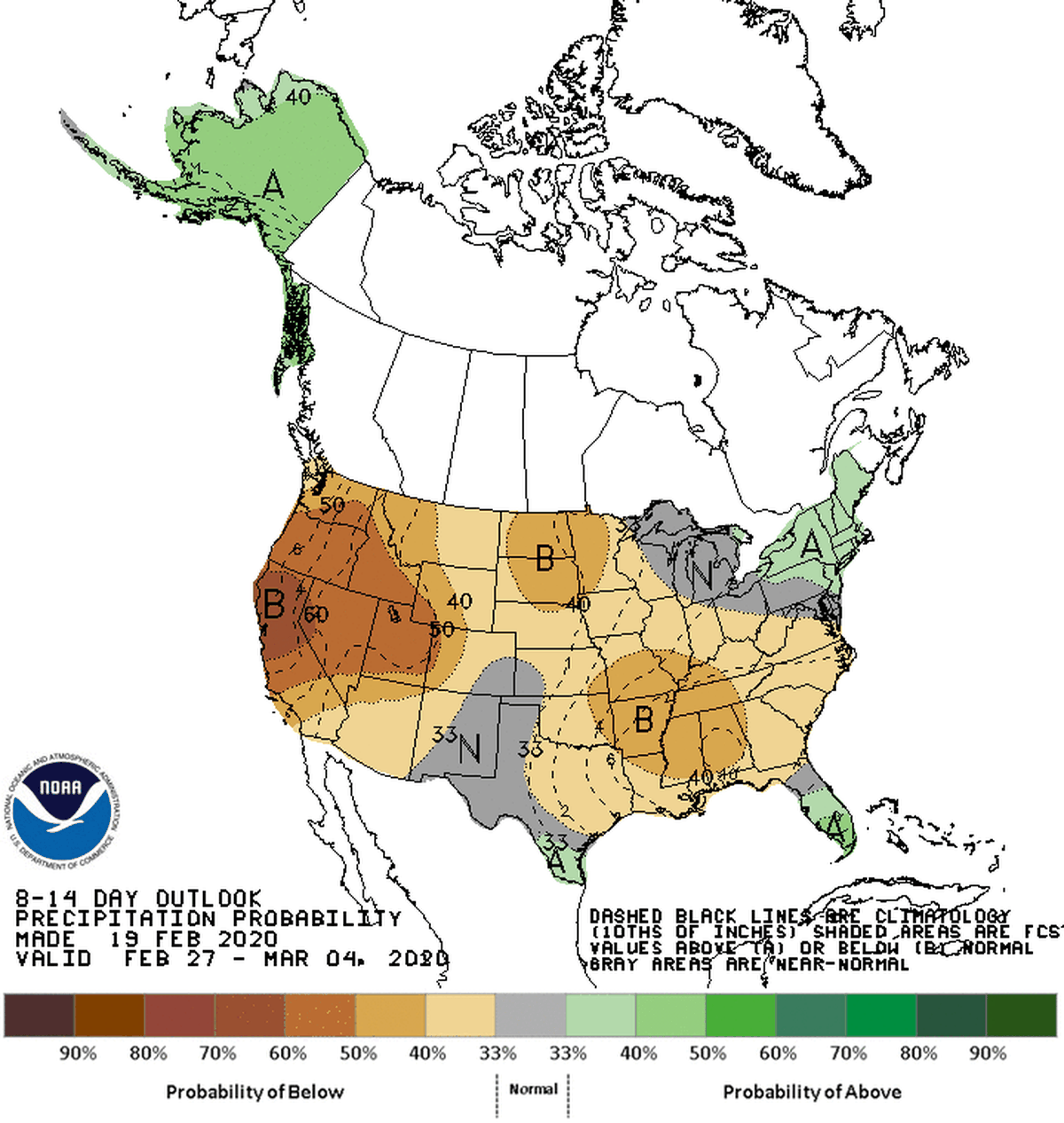
The NWS Climate Prediction Center on Thursday also released its long-range forecast map for March, which shows all but the far northwest corner of the state as having about a 40 percent chance of coming in below average precipitation levels by the end of the month.
The 8-to-14-day outlook, extending from Feb. 27 to March 4, shows between an 80 and 90 percent probability of below-normal rainfall for Northern California, the only region in the U.S. shaded a dark brown to indicate the very low likelihood of rainfall.
In other words, if a “miracle” comes, it would need to play catch-up after getting a start in the second week of March.
And if it doesn’t happen in March, it probably won’t happen before the heat of summer rolls in. Sacramento in April, for instance, has seen more than 3 inches of rain just one time in the past 37 years, in 2006.
The good news is that California’s dry spell is still fairly recent. Unlike 1991, we’re not currently in a statewide drought; reservoirs throughout the state still have solid stores thanks to an exceptionally wet start to 2019; and snowpack in the mountains is currently about triple what it was on March 1, 1991, though there are still nine days left in February for more Sierra snow to fade.
The main concern is wildfires. As Swain told The Bee earlier this month, a lack of soil moisture can worsen wildfire risk, for a region that has already seen a variety of weather- and non-weather-related factors amp up the danger in less than a decade.
This story was originally published February 20, 2020 at 11:54 AM.