Did this week’s big storm help with California drought? What about wildfire season?
A strong winter storm this week made for a good start, but it will take a lot more rain and snow in the coming months to put a significant dent in California’s drought.
Still, the storm’s solid precipitation totals could be an important asset in the coming weeks as the state looks to close the book on the current wildfire season.
The U.S. Drought Monitor, in a weekly update published Thursday, still reported the entirety of the state in at least “abnormally dry” conditions, with 88% of its land area in at least “severe” drought, 41% in “extreme” drought and 17% in still-worse “exceptional” drought.
Those numbers signify slight improvements compared to last week: the “severe” percentage dropped by four points, from 92%; and “extreme” by two, from 43%. The proportion of the state in “exceptional” drought status remained unchanged.
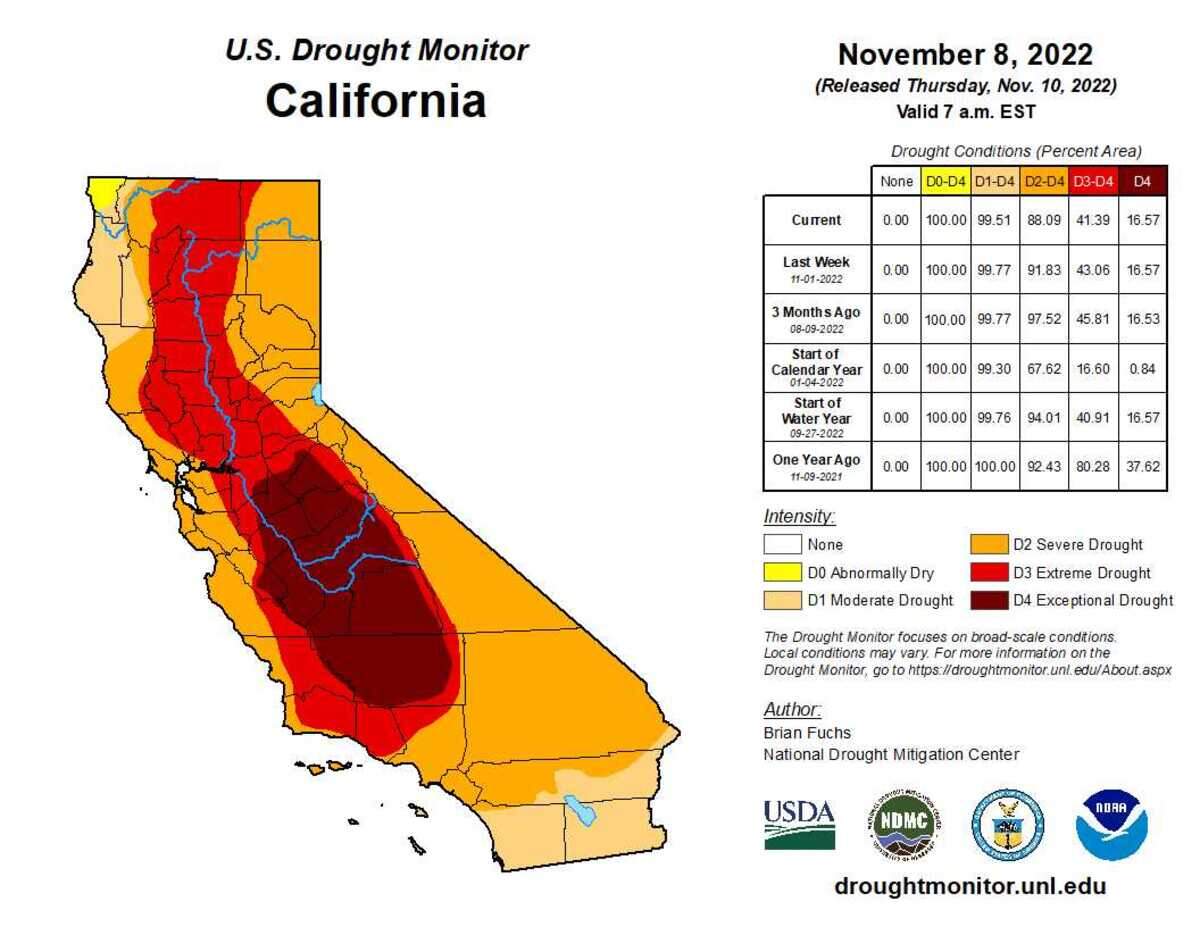
Extreme drought — or worse — still dominates the entire Central Valley, with exceptional conditions covering essentially the entire southern third of the valley, data from the federal monitor showed.
More than 2 feet of snow fell in parts of the central Sierra Nevada mountains in the recent storm, while more than 1½ inches of rain dropped on various parts of the Sacramento Valley.
Those are welcome early November totals for a drought-battered state, but as the past 13 months have demonstrated, a strong start isn’t always enough. Parts of Northern California scored record-smashing precipitation last October, including the rainiest day ever recorded in Sacramento history; and the central Sierra also got more snow last December than in any previous December.
Then, the state dried up from January through March, with record-low precipitation followed by unseasonable heat in the latter month quickly depleting the Sierra snowpack.
As water and state weather officials have said for many months, busting California out of the current drought would require sustained precipitation, in the form of strong storms continuing through the state’s traditional wet season.
“This winter (2021) has demonstrated that as the world continues to warm, we’re seeing average conditions become more rare,” Jeremy Hill, a hydrology and flood operations manager with the Department of Water Resources, said in a March snow survey near Echo Summit.
What about California’s wildfire season?
Widespread rain and snow this week should serve to keep fire fuels damp for at least the next couple of weeks.
Cool and wet weather “has significantly mitigated flammable fuel alignments across the region,” the National Interagency Fire Center wrote Thursday in a seven-day outlook report for Northern California, “therefore little to no significant fire risk exists.”
The center in a four-month outlook for November through February labeled fire potential as “normal” for this time of year.
Some of the worst fires in state history, including the November 2018 Camp Fire that razed Paradise and killed 85 people, have fallen from October through January – a stretch when furious wind gusts meet dry fire fuels in parts of both Northern and Southern California.
Entering November, the 2022 wildfire season has shaped up to be far less severe than in recent years, the Mosquito Fire in the foothills and a pair of deadly blazes in Siskiyou County notwithstanding, Cal Fire numbers show.
Cal Fire in an update Monday reported this year’s total acreage burned at 362,370, or 566 square miles.
That’s less than 15% of the year-to-date total for 2021, of nearly 2.5 million acres, and only 17% of the five-year average of 2.1 million acres from Jan. 1 through Nov. 7, going back to 2017.
Fire authorities and ecologists have credited measures including prescribed burns and forest-thinning projects, in part, for this year’s tamer wildfire conditions.
There’s also an element of good luck. Four of the seven largest fires in state history broke out during a very powerful dry lightning storm in August 2020, with lightning strikes also causing large fires in 2021. No major lightning incidents have been reported so far this year, though climate experts have said those types of extreme events will likely become more frequent due to climate change.
The Mosquito Fire, which sparked in El Dorado and Placer counties from early September until being fully contained on Oct. 22, finally calmed down with the arrival of a seasonally strong storm that doused the blaze with rain in mid-September.
At 76,788 acres (120 square miles), the Mosquito Fire stands as California’s largest wildfire of 2022.
Some Cal Fire units enter winter mode
Climate change has turned California’s wildfire season into a year-round affair, though officials do still make fire season declarations.
All 21 of Cal Fire’s units, for instance, entered their “summer preparedness” mode sometime between mid-May and mid-June this year, similar to recent years, according to the Cal Fire website.
Cal Fire’s Lassen-Modoc unit shifted to its “winter preparedness” mode on Thursday, signaling a shift away from peak wildfire season, and the agency’s Butte unit will do so Monday. The winter declarations have not been set yet for the other 19 units.
From 2018 through 2021, none of the agency’s 12 Northern California units entered winter preparedness earlier than December.
This story was originally published November 11, 2022 at 6:00 AM.