
I now believe in the July 4 American ideal, not the July 4 American illusion
READ MORE
The Fourth of July
Marcos Breton, Yousef Baig, Hannah Holzer and Jack Ohman.
Expand All
Fourth of July 2021: We celebrate so independently we forget to welcome each other
I now believe in the July 4 American ideal, not the July 4 American illusion
The American melting pot is a myth. On July 4, I’m reminded of the cost of being different
My generation is less willing to identify as patriotic. That doesn’t mean we don’t care about our country
My first clear recollection of July Fourth is from 1964, when America was a very different place.
The United States had just experienced the assassination of President John F. Kennedy. This country had not yet made that giant leap for all mankind he called for in 1961, and our presence in Vietnam then was “advisory.”
I was almost 4 years old in 1964. My parents had taken me to the July Fourth parade in downtown Marquette, Michigan, a small college and iron ore town on Lake Superior. July Fourth was probably the only reliable date that didn’t feature snowbanks and 40-foot ice floes on Superior’s shore.
I vividly remember policemen throwing candy to the kids in the crowd, and that a car very nearly ran over my foot by the sidewalk.
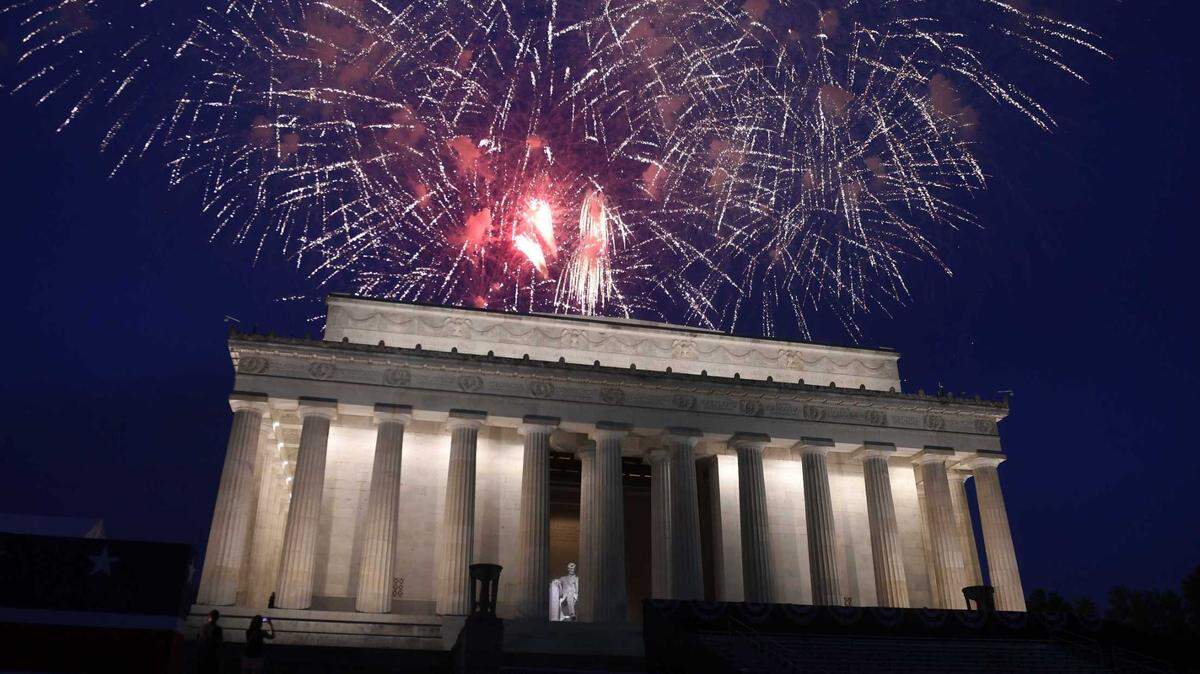
Later that day, we went to a fireworks display, and I puzzled over one in particular. It was a flare-infused portrait of an old man I didn’t recognize.
Decades later, I finally decided it must have been a pyrotechnic display depicting our new president, Lyndon B. Johnson.
Like most Americans, I enjoyed July Fourth celebrations. It was a time for family and neighborhood gatherings, fireworks (which, for some reason, I had become increasingly fond of in my 30s and 40s) and general carousing under the banner of patriotism.
I now realize that my patriotism was firmly rooted in the American archetype: White men had come to Virginia, established freedom, written magnificent documents based on John Locke and other European political philosophers, expanded the nation’s boundaries and produced leaders such as George Washington, Thomas Jefferson, John Adams, Alexander Hamilton, James Madison and Abraham Lincoln.
In short, I was spoon-fed the American canon. I bought into it, too. For a time.
Changes in how we perceive our history
In 1998, after a 20-year hiatus, I went back to finish my college degree and studied U.S. history.
In 1978, we were still studying great battles this nation had engaged in. Oh, sure, we had cursorily studied slavery and other inconvenient American subjects, but by 1998, the emphasis had shifted dramatically in the U.S. history college curriculum.
Gone were battle studies. In fact, in my first U.S. history course upon my return, I gently asked my professor when we were going to do battles. I had flipped through the textbook and had seen very little mention of them.
“We don’t really do battles anymore,” my professor noted.
What we did study were vast social movements.
Slavery was covered intensively, as were women’s rights. Struggles over labor and workers’ rights were extensively explored. These were the actual battles that framed our national consciousness as we know it today.
No founding father or political assumption of the white male power structure was left wanting, either. I wrote a paper on Jefferson that came to the conclusion that he was, in fact, a hypocrite, but he had also laid the groundwork for the ultimate eradication of slavery.
Ready to celebrate
Studying U.S. history in two entirely separate eras proved very useful to me. It made me appreciate my own family’s sacrifices and immigrant struggle more clearly.
I wasn’t exactly raised in privilege. My dad got a Ph.D. on the G.I. Bill, due to his service in Korea, where he was awarded the Bronze Star for valor. He got a cheap V.A. home loan. Both he and my mother were raised in solid, middle-class homes, but everyone worked for a living. Mom’s brothers and uncles were at D-Day, the Aleutians and Pearl Harbor.
I worked as a dishwasher, a yard guy and a picture frame fitter. I put myself through college out of my own pocket. I complained bitterly that my parents didn’t hand out $100 bills like some of my friends’ folks, but I know this helped me later in life.
When Donald Trump was elected president in 2016, I came to terms with the fact that the American ideal had been replaced with Potemkin Village America, where the façade was more important than the structure.
I can’t say I enthusiastically celebrated July Fourth, either. I went to the picnics and I watched the fireworks, but I knew that the country was far more internally damaged than I had thought.
The GOP used to put up candidates like Oregon Sen. Mark Hatfield, who I enthusiastically voted for twice.
By the Donald Trump era, that party was dead. Jan. 6 exposed the rot in the foundation.
Now I believe in the July Fourth American ideal, not the July Fourth American illusion.
I love this country. I love the idea of the country, and I appreciate diversity more living in Sacramento than I ever did in Minnesota and Oregon.
With the election of two sane professionals to the presidency and vice presidency, one of whom is the face of the new America, I can say now that July Fourth is something I will happily celebrate.
But I did quit fireworks. I need my fingers.
This story was originally published July 4, 2021 at 5:00 AM.