
My generation is less willing to identify as patriotic. That doesn’t mean we don’t care about our country
READ MORE
The Fourth of July
Marcos Breton, Yousef Baig, Hannah Holzer and Jack Ohman.
Expand All
Fourth of July 2021: We celebrate so independently we forget to welcome each other
I now believe in the July 4 American ideal, not the July 4 American illusion
The American melting pot is a myth. On July 4, I’m reminded of the cost of being different
My generation is less willing to identify as patriotic. That doesn’t mean we don’t care about our country
In Placer County, love of country seems to come easy to most residents.
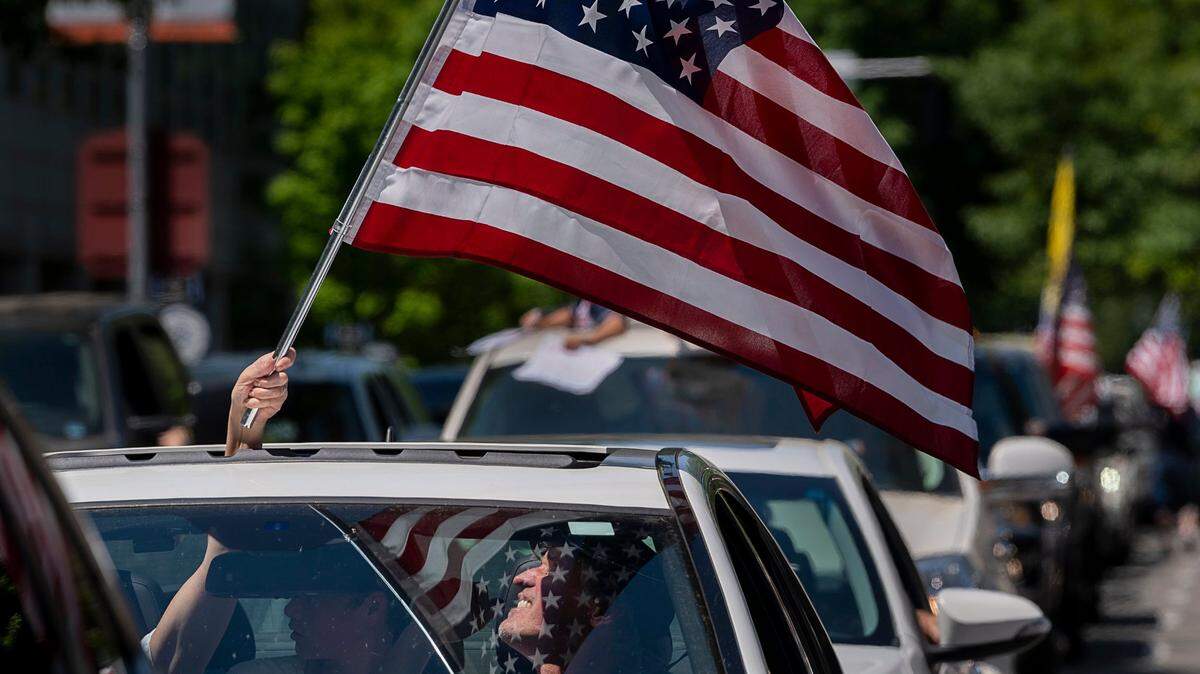
Here, patriotism is a statement: American flags on trucks and houses; USA-themed school concerts and spirit days; and enthusiastic celebrations of the Fourth. The evolution of patriotism during the Trump presidency has also been evident in our community – as the MAGA and Thin Blue Line flags became proxies for the American flag. In the 2020 election, more than 52% of Placer County voters cast their ballots for Donald Trump.
“I believe ‘patriotism’ is now a loaded word that is sometimes used as a weapon by politicians and some in the media to justify their position on an issue or to heap scorn on those they disagree with,” said Ron Severson, a long-time Placer County educator and former Roseville Joint Union High School District superintendent. “We have lost the nuances and complexity of what it means to love our country.”
Severson, who has had a 40-year career working at California high schools, previously worked as a consultant for the State Department of Education on its social science frameworks. Studying political science and history in college, Severson said he did not learn about events in U.S. history such as the Tulsa Race Massacre, Juneteenth, redlining and the Wounded Knee Massacre.
“Kids need a more unvarnished picture,” Severson said. “Since the common core, most social science instruction is moving in that direction, (but) we have a ways to go.”
A famous James Baldwin quote is often used as a stand-in definition of progressive-minded patriotism: “I love America more than any other country in this world, and, exactly for this reason, I insist on the right to criticize her perpetually.”
Whenever I think about national pride, I return to this observation. I criticize my country because I care about it. I hesitate to say that I love America. I struggle with the concept of national pride, much less love of country, because I know that blind patriotism can too often and too easily morph into a more robust form of jingoism, laced with racism and violence.
Patriotism, too, has taken on new meaning in recent years, having become synonymous with the abhorrent values of the Trump administration and the self-identified “proud patriots” too often aligned with white supremacist beliefs.
Patriotism’s downward trend for the young
For Oregon State history professor Christopher Nichols, who specializes in U.S. cultural and political history and the country’s global relations, patriotism is inherently and historically exclusive.
“It’s not necessarily about who’s included; it’s about who’s excluded,” Nichols said. “The big problem with thinking of patriotism as just an unalloyed position is that, by definition, patriotism’s exclusivity undermines its universal project.”
Placer County adheres to a type of in-your-face patriotism that is more performative than authentic. I also find it to be exclusionary in a way similar to what Nichols describes.
I am not an archetype of my more conservative town – I am a third-generation feminist and a liberal, Jewish woman whose large extended family includes queer and trans people and people of color.
When I look at the American flag, especially when it’s tacked to the back of a truck driving through Roseville or Rocklin, I know that my family is likely excluded from that person’s vision of America.
The American flag is, after all, a symbol. While the flag can change meaning depending on the context, some young people, myself included, see the American flag as a divisive symbol that has been co-opted by the right.
More broadly, my generation is also struggling with or outright rejecting national pride. A Gallup poll from 2020 found that just 20% of Americans ages 18-29 identify as “extremely proud” to be an American. For the sixth consecutive year, Gallup reported record lows in American pride.
Nichols believes the Trump presidency, 9/11 and the 2008 recession could be partially responsible for the downward trend, especially for younger Americans. Dr. Susan Brewer, author of “Why America Fights: Patriotism and War Propaganda from the Philippines to Iraq,” added that 18- to 29-year-olds are also more globally-oriented.
“They do tend to think and act much more globally, and that’s going to set them against nationalism,” Brewer said.
To get a better, albeit unscientific, understanding of my generation’s relationship to patriotism, I asked. I polled via Instagram. Of the 119 individuals who responded, the majority of whom are young millennials (above the age of 25) or older Gen Z (below the age of 24), 82% said they don’t consider themselves to be patriotic. Asked whether our generation cares about patriotism, 75% said no.
Conflicting emotions
I still, however, feel guilty admitting that I’m not patriotic. Partially, this is because I have been taught to regard national pride as pure and noble. This is also because I have intimately observed the curious knee-jerk reaction from the right to subscribe to an America: love-it-or-leave-it response to any criticism of the country.
That reaction was challenged last summer after the police killing of George Floyd when suddenly we, as a country, were forced to reckon with our racist history — not just look away. From Nichols’ perspective, what’s being argued now is whether we can address our country’s difficult history and still be proud.
“What I’ve tried to do is embrace people’s desire to be patriotic and then channel it in a direction to say, ‘To do so you have to look the difficult history in the face,’” Nichols said. “You don’t get to say, ‘I love this country,’ and then not say, ‘Here are moments where it failed to live up to its ideals.’ Nothing has faded, we can change our path by knowing the past.”
I cannot give America my allegiance or devotion, but I can strive to give it tough love. While my neighbors and I might not share the same political beliefs, there is one patriotic act I fully endorse: voting.
“We have seen clearly in the past two elections that simply choosing to vote or not has gigantic consequences,” Severson said. “We need people to engage. To not vote is the most unpatriotic act I can think of.”
There’s another James Baldwin quote that perfectly encapsulates how I feel at this moment: “Not everything that is faced can be changed, but nothing can be changed until it is faced.” When we acknowledge our past, we can reconcile with it. Now is not the time to look away.
This story was originally published July 4, 2021 at 5:00 AM.