
On the issues: Ken Cooley and Josh Hoover, candidates for 7th District Assembly seat
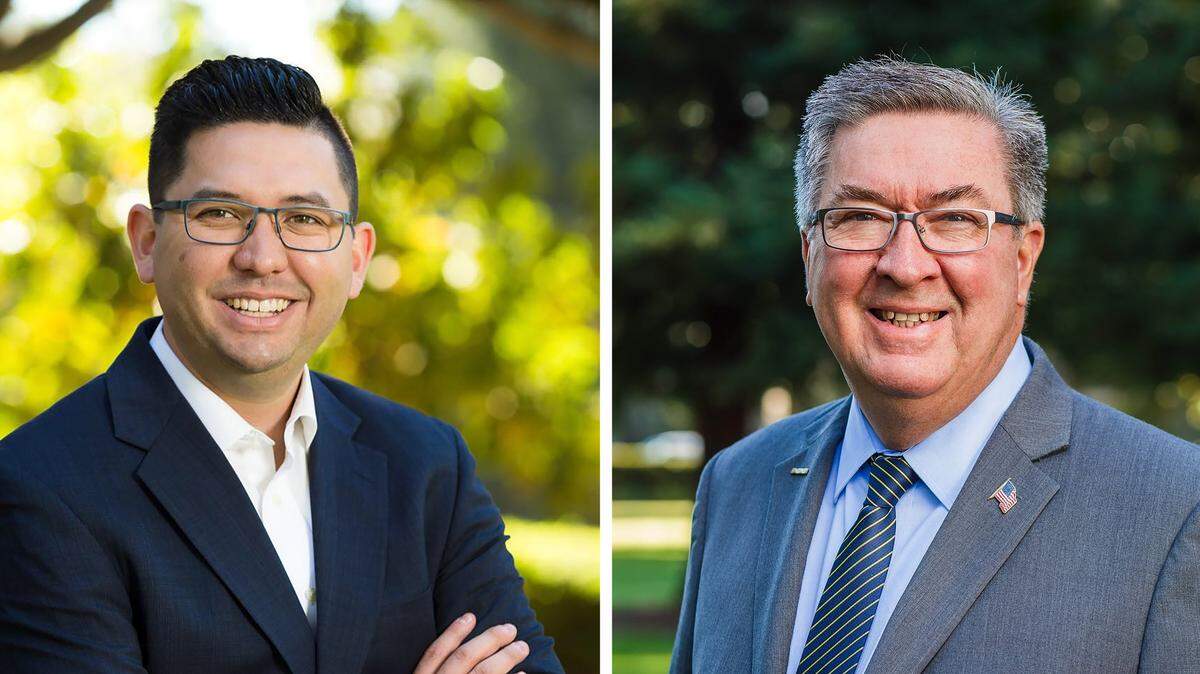
The following interview was conducted by members of The Sacramento Bee Editorial Board and the two leading candidates for the 7th District state Assembly seat, Assemblyman Ken Cooley and Josh Hoover, who serves as chief of staff for Assemblyman Kevin Kiley. It has been edited for length and clarity.
The Sacramento Bee: Can you introduce yourself and tell us why you are running for the state Assembly?
Cooley: I currently serve in the assembly – I served 10 years on the Rancho Cordova City Council. I was one of the founders there. And then at year 10, the last time remaps were done, there was no Assembly member in my area, and I opted to run. So I’m in my 10th year in the Assembly. This year, my wife and I will have our 47th anniversary, and that’s relevant because we have lived in this district for 45 years. We moved here about a year and a half into our marriage. Our son grew up here. Both went into ministry, although my youngest son is just transitioning from Foothill Church, across the county line and Cameron Park, and my son is still senior pastor at our church. I’m running because I have a history in the institution and enjoy what I do. I’m not jaded; I feel an opportunity to make a difference every day. I moved here because I was hired into the Legislature as a young guy to the chair of the Rules Committee. And I’d never worked a day in the building. He’d gone through three people in four years. He and I were together for eight years. This means I’ve actually seen the unicorn as a lawmaker – I’m the only lawmaker in California who’s not only seen but worked on a successful veto override. I’m sort of the author of increased accountability. We have a guide to accountability, to oversight on the Assembly website. I got that published online five years ago as Rules chair. I’m a leader in oversight nationally at the Council of State Governments West, where I’m involved in oversight, and through the National Council of Insurance Legislators, where I’m also national president of 50 state organizations of lawmakers, so I know a good deal about insurance. I feel I am the only member in this institution – aside from my senator, Jim Nielsen – running as a member of stature. They knew the office; they knew how to conduct their work in a collegial manner. I treat all my members well. I am working on getting funds for rural California in a rural infrastructure act to serve primarily our smaller counties – the great state of Jefferson, as I remind my colleagues in the Capitol. I will be the member with my history that trains the new members that come in. As Rules chair, I oversee training of all the members. At this watershed election, my career is focused on the institution, on oversight, on respect for colleagues and moving the ball forward. It’s an honor to serve, and I look forward to serving two more years.
Hoover: I am a parent of three. I grew up in this community, in Folsom, and left for a little while. When my wife and I started to have our family, we wanted to come back and raise our kids here. I think that’s what a lot of folks choose this community for and love this community for. I’ve been raising my family here for many years – we have a 13-year-old, a 10-year-old and an 8-year-old. I’m also a Folsom Cordova school board member. I was elected in 2018. And I’ve also worked in the state Legislature for over a decade for numerous members of the Legislature. When I was elected to the school board in 2018, none of us really knew what was about to hit us with the COVID-19 pandemic and all the challenges that were raised, particularly for schools. I’ve talked to a lot of local elected officials and state elected officials and I think they all agree that school board positions may have been one of the toughest jobs in the last few years. I worked very hard over the last few years to safely reopen our schools. Folsom Cordova was the first district in Sacramento County to bring kids back to in-person instruction. I’m also the father of a child on the autism spectrum, and one of my priorities has been our special education students. We worked very hard during the pandemic to make sure that, as soon as they were able, our special education students were able to come back for as many days as possible per week because they had the most challenges with Zoom school. I also pushed for new transparency measures and pushed for requirements that we livestream all of our meetings. We just recently scored a major victory by approving all-day kindergarten starting next year in our district and also increasing instructional minutes for our first- and second-graders. I’m running because I love this community and I really think we need a return to commonsense policies in California. I think our residents in this community want great schools, they want safe neighborhoods and they want to be able to afford to live here. I’ve had many friends that have left the state, sadly, not just because of the politics, but because they just can’t afford it and they want to be able to own a home. I think Californians are looking for change. I think they’re looking for a more balanced Legislature and someone that’s going to work across the aisle to get things done.
The Sacramento Bee: The Legislature has obviously struggled in recent years to make a dent in the vast housing shortage we have, which has repercussions in terms of housing prices and homelessness. A recent law legalizing duplexes and fourplexes in most of the state is already facing a lot of resistance from local governments. What do you think the Legislature can and should do to expedite the massive amounts of construction that would be needed to get us anywhere near a normal level of housing supply?
Hoover: As the father of a young family, I think we need to get California back to a place where we can have young families able to afford to buy a home and raise their family. I think some of these recent efforts in the legislature may be nibbling around the edges. When Governor Newsom was elected, he committed to building 3.5 million homes in the state. I was fully on board with that. We absolutely need to do that. But we haven’t seen the follow-through on that. And we’re going to need more than these just nibbling bills to get that done. We need broad CEQA (California Environmental Quality Act) reform that’s not just for sports stadiums but for actual housing projects. Governor Jerry Brown called that the Lord’s work when he was in office, and I want to see that for housing projects across the state. Until we see major reform on that issue, and a major slashing of fees and regulations on builders, we’re going to continue to have this housing crisis. That’s combined, obviously, with the cost of building materials going up. When you add up all those costs, families just can’t afford those homes.
Cooley: I am in the position of being a legislator and a lawyer, but in ’04 I got involved with the (League of California) Cities, and by ’09 I was the statewide first vice president. If it was time for a career change, I would have been president of the statewide league. When that auxiliary dwelling unit bill came through, I was strongly in support of it and I actually felt it was important for me, as a past leader of the League of California Cities, to say, “We can live with this; this is not a problem.” We need to look hard at how we support infill areas. Josh and I both live in communities that are growing rapidly. I have walked all the new neighborhoods south of Highway 50 since January — I love going door to door. We’re growing in those areas, but those are greenfield areas. Those are a lot easier to build than infill. I think we need to look at: Where do we put our priorities to support growth and enhancement where it’s needed? I mentioned my rural California infrastructure bill. With all this money we have, I’ve had the view for several years that we should set aside a billion dollars and let local governments in our smaller, less populous counties spend it on their local priorities, which could support infrastructure that would sustain housing. If you want to do something, you have to release energy. That bill — more than money — is trying to release energy at the local level. I do know that in Rancho Cordova we have Folsom Boulevard, which has been developed since before ‘50. That is very expensive to ask a developer to come in and add something new, even though it’s infill. And it’s more sustainable because there’s less driving involved. We, as a state, ought to look at committing capital to infill areas where growth is possible so that some of the essential infrastructure can be borne by that mechanism. In the old days, prior to Prop. 13, which I’ve been a strong defender of — even to the point of opposing Prop. 19, which passed, but I wrote the ballot argument with the property tax limitation committee against it to protect Prop. 13 — we haven’t had a good way to pay for that infrastructure. That’s what came readily out of the old system. Today, it has to come out of the developer. If we put some of that money into the ground, to help areas get ready for development, protecting infill areas, that’s solving a big problem that can lead to less costly infill housing.
The Sacramento Bee: I think it’s important that we maybe address the elephant in this race, which is the fact that in addition to running against each other, you’re also running against an out-and-proud Proud Boy. I’m wondering what you think about that? Does he have a shot at winning? And are you willing and able to denounce the Proud Boy organization and white supremacy?
Cooley: That is not welcome in Sacramento County, and I’ve already done a mailer on that single issue. I actually think it is worrisome. We live in a great community, but there is wide, divergent opinions. And when you have four Republicans in the race, as we have here, and somebody who will probably assert that they’re the real Trump candidate in the race — probably that’s kind of the rhetoric — it’s kind of a big wildcard. I’ve actually already got blowback because I did do a mailer on this issue. I tried not to take the stance that I hate the Proud Boys, because that’s same-same. But I’m a former scoutmaster; I do Eagle Scout courts of honor all over the region. I’ve done 200 Eagle Scout courts of honor. There is a baseline of just solid community people that I think need to be reminded, as Abraham Lincoln said, of our better angels. What’s a sustainable path for our community? It’s why I treat my colleagues with respect. I don’t serve with 60 elected officials, I serve with 120. We all need to work together. I feel it’s very vital that we model that, and I think any race I’m in is going to model that idea — we govern with respect for all, collegiality toward all. That’s how you build a future together. And anyone who takes a different stance, I think, is stepping on the air hose of the future.
Hoover: I am absolutely happy to denounce the Proud Boys. I won’t even honestly mention the candidate’s name, but I think the fact that this person is in the race is unfortunate. And we’re not going to take anything for granted. We’re going to beat him on our side, as one of the four Republicans in the race. We plan to be the top Republican at the end of the primary. Just a reminder that this is the same gentleman that was kicked out of the Republican Party in Sacramento County because of his radical associations. We can’t have someone like that representing us, and I’m happy to be running to win for the Republicans in the primary to make sure that doesn’t happen.
The Sacramento Bee: Josh, your boss, Assemblyman Kevin Kiley, has posted a photo with neo-Nazi Chelsea Knight, who’s an administrator of a neo-Nazi Telegram channel. He also agreed to serve as a featured speaker at a March 2021 rally co-organized by Cordie Williams, who, two months before, publicly called on Americans to arm for civil war. Could you address the fact that you’re willing to denounce the Proud Boys, yet, meanwhile, your boss has posed with neo-Nazis?
Hoover: I don’t know the background on any of that, but I can tell you right now that elected officials take photos with a lot of people. I think Democrats and Republicans on both sides throughout the state can admit that they don’t always know who they’re taking photos with. So I can’t really comment beyond that because I don’t know any of the other information.
The Sacramento Bee: California has more and tougher gun laws than most other states, but legislators are still looking for ways to stem the sort of violence that has wracked Sacramento this year. Should the Legislature pass an excise tax on guns to fund violence prevention programs, a version of which died last year for lack of support? What else can state lawmakers do about this?
Cooley: I will not support the excise tax, and I’m part of the reason it didn’t move forward. Mr. (Assemblyman Marc) Levine’s bill — I told him I would not be supportive of that. We do have really strong gun laws in this state, but we’re sort of having a breakdown in relationships. It’s a broader issue than the gun itself. My wife was a bookkeeper for a church for 42 years until she retired. Both my sons started their professional life in ministry. That’s not to say that our particular denomination is the way of the entire world. But I think we need to find ways to support active and engaged civic life. Well-to-do California setting aside $1 billion for our smaller, less populous county is actually modeling the way democracy ought to work. I’m often a no vote on some of the strong gun laws. I won’t support that tax. We need to focus on just how we function as a society. Part of what makes me different in the Assembly is that I’ll stand up on the floor of the assembly and speak out against that bill, as I did with (former Assemblywoman) Lorena Gonzalez’s AB 257 (regulating fast food restaurants) in June of last year. We’re in the process of rebuilding the Capitol, and under my leadership, my Republican colleagues have the best offices of their careers. I didn’t put them in little tiny spaces. You need to walk the talk of collegiality, and we need to model that as leaders.
Hoover: I don’t support that bill; I don’t support a tax on guns. Honestly, I think you made the point in the question — California has some of the strictest gun laws in the nation, and these tragedies are still happening in our communities. I certainly support any efforts that are being done to take guns out of the hands of criminals. We have to do that. That is something I believe our current A.G. (state Attorney General Rob Bonta) has tried to improve. We have to improve that. As the Legislature, we have to support those efforts. When it comes to gun laws, they tend to affect law-abiding gun owners, but it does very little to stop criminals from getting their hands on a weapon. If the Legislature is serious about stemming the tide of violence in our communities, they need to look at other policies that are failing California. Just as an example, we have had two tragedies here in the Sacramento region in recent weeks, one of which involves someone who was let out of jail based on regulations that allowed for more early release credits. That’s something that’s been discussed today at CDCR (the California Department of Corrections and Rehabilitation), and I think that’s something that we cannot continue in this state. Rehabilitation is critical. We have to rehabilitate our inmates, but we cannot let people out early who have not been rehabilitated. It’s that simple. The second thing is our sanctuary state policy. We passed the law a few years back that bans our law enforcement officers from communicating with federal authorities when a criminal is released who is in this country illegally. We need to seriously take a look at that policy. In one of these tragedies that happened recently, the gunman had been arrested just a few days before for assaulting a police officer and was sent back out on the streets, and ICE (Immigration and Customs Enforcement) was not notified. We have to look at the root cause of some of these issues and ask ourselves, “Has the pendulum swung too far?” We need to readjust some of our criminal policies to make sure that people are not being let out when they shouldn’t be.
The Sacramento Bee: Sacramento area lawmakers are backing a bill that would clear encampments of homeless people from the American River Parkway. Given the lack of shelter and housing for them to relocate to, do you believe that this bill is reasonable?
Hoover: I believe Assemblymember Cooley is one of the authors of that bill, so I would assume he supports that legislation. I support this effort, absolutely. Honestly, I think we could even go farther and expand it to other public spaces such as our public parks. Our community wants to make sure that people have housing. But at the end of the day, they also want to be able to use their public facilities, their public trails or public parks, as the taxpayers have paid for those facilities. We have to find a way to do both of those things. It is a housing issue, but it’s not just a housing issue. There are so many folks in our homeless community who, you can give them housing, but that does not again solve the root cause of their problem. In so many cases, we need to expand mental health treatments and make sure that it’s possible for people to get the treatment they need. We need to get people substance abuse treatment for drug-related issues. One of the most unfortunate things in the last few years — that I think is underreported — is when voters passed Proposition 47. A lot of Proposition 47 focused on smash-and-grab crime, which I think is a terrible thing. But the other thing that Prop. 47 did is it completely gutted our drug courts, it took away incentives for D.A.s to offer substance abuse treatment as an alternative to jail time. And as a result, we have fewer people seeking drug treatment. And I think that is contributing to our increase in homelessness. The reality, too, is that our state has spent $12 billion or more on homelessness in the past few years. And the problem has only grown — we have more homeless on our streets today than we had three years ago. And I think that’s something that we seriously need to look at. We need to audit our homelessness spending in California; we need to audit those programs, and we also need to identify the programs that aren’t working and make sure we’re not funding programs that aren’t working.
Hoover: With respect to that bill, I am the lead author — it’s my bill, with Mr. (Assemblyman Kevin) McCarty and Mr. (Assemblyman Jim) Cooper joining me on it. I actually believe that the case in question, Martin v. Boise, is being applied too broadly. It was settled by the Ninth Circuit and was passed over by the Supreme Court review; therefore it is good law. But I’m a lawyer, and I think the way that it is being applied is too broad. I agree with Josh. Wildness is the preservation of mankind, long ago said by Emerson. For decades, the Parkway has opened at sunrise and closed at sunset. That’s not just a people rule; it’s because this is a wildlife habitat. People want to be able to get out there and discover what lives there. They don’t need people junking it up at all hours — that goes against making it a welcoming place for habitat. Animals that are native to the region can settle there and be safe at night. I used to work with Mills Middle School; we’d take them camping to Monterey Bay every couple of years – the teachers ran a math and science camp, and I ran the campsite. I did this even before and after I became an Assembly member. These kids don’t experience the outdoors except in the Parkway. One of the great things about Rancho Cordova is that we maintain housing for 30-38% of the county’s emergency and transitional housing. It’s housing supported by services, and never did that lead to a peep of unrest in the community because it had that model — it got people in housing with services. It’s the same model used by the Housing Assistance Relief Team program. People have to get vetted on the way in, make sure they’re not drunk or on drugs. If they pass that test, they get to another place where there’s clean conditions for living and housing. They get fed, they have breakfast in the morning. I support all of those things. I don’t know how we solve this issue, but I definitely believe parks are special places that are set aside for special purposes. To say that somebody with a tent can set up in the Parkway is astonishing.
The Sacramento Bee: There’s a mountain of research showing that homelessness is pretty closely tied as a matter of statistics and reality to the lack of housing and the price of housing. California has fewer homes per capita than just about any other state. There’s just nowhere for people to go — there’s no shelter for the people who are going to be cleared from the Parkway. Most of them will end up camping somewhere else. Isn’t it your obligation as a legislator and someone running to be a legislator to explain to us why we’re rousting people out of where they live even though we don’t have anywhere else for them to go?
Cooley: In companion to the bill, there’s a budget appropriation proposal for $50 million to support the county in its programs. It is a bill coupled with a budget move. Mr. McCarty, who does the budget work, is working on that. I guess, to me, I don’t think it is inherently inconsistent as a public official to say that we’re going to provide housing for people someplace, but someone cannot just upend other important public values because they want to pitch a tent and be there. The gentleman that brutally murdered Emma Roark was just camped out within a mile of my home. These sorts of things affect people’s willingness to even enter the Parkway, and in the long term, that spells trouble. FDR said a long time ago, you sometimes have to be able to operate with two inconsistent ideas in your head at the same moment and retain the ability to function. I do think that communities need more than the homes that are situated in them — nearby areas, parks, Parkway, those are actually very important. My bill focuses strictly on Parkway types of places. Going back to 2013, I was active on the Homeless Working Group in the League of Cities. I have a huge interest in it. I’ve always defended what we do in Rancho Cordova. When I was on the city council in 2006, we had an affordable housing ordinance adopted in Rancho Cordova. When I left the City Council, Rancho Cordova did change the policy to get rid of that affordable housing ordinance in the new-growth areas. That’s unfortunate, but I still think we do need to help the developers. It’s all a very complicated financial mess. But I’ve actually fought for affordable housing ordinances. I support ADUs (accessory dwelling units). I had a rapid rehousing bill modeled on the Utah one. It’s complex for everyone, including homeowners who live near the Parkway.
Hoover: You’re not going to get any argument over the lack of affordable housing in California. It’s very difficult to not just purchase a home but to even afford rent right now. There has to be solutions for that. But I think we get into this challenge with homelessness where we talk about it as kind of a singular issue with a singular type or definition of what homeless means. The reality is that those who are homeless are homeless for different reasons. For a lot of folks in our community, it was an affordability issue or they lost their job or they had a bad break in life. There are services to help those folks, and we can certainly have a conversation about expanding those services. But there are certainly shelters and job programs and things in our communities that are being run by our counties in our cities to help folks get back on their feet. And we can have that conversation about how to better do that. But there are also folks that are homeless either because of substance abuse issues or mental health issues, and we can also have a conversation — and I think the governor has started doing this — about what we can do to, for example, get people into mental health treatment. The reality is, we can’t talk about it as one specific problem because I think it’s many different problems. My house is literally next to a park, and occasionally we will have homeless people in that park. My neighbors and I have found needles in our park where my children play. This is a public safety issue. We cannot say that just because these folks don’t have another place to go that we need to let them take over our public spaces. I don’t think that that’s a fair solution — I don’t think that’s fair to the taxpayers, and I don’t think that’s safe for the families whose kids want to use these facilities and these trails. We need to come to a place where we can talk about this issue holistically. But no, I do not feel that those who are homeless have a right to these areas just because it’s the place they’ve decided to pitch their tents.
The Sacramento Bee: The Public Utilities Commission is considering a reform of rooftop solar programs that give generous subsidies to households and make it easier for widespread adoption. Utility companies say the cost for these programs gets pushed onto lower-income residents. Two-part question: Where do you stand on this issue, and what role does rooftop solar play in California’s clean energy transition?
Hoover: I feel pretty strongly that we need to keep the promise that we’ve had for the solar owners for a long time. The system that we set up, I think we need to keep it that way and make sure that we’re not taking away the benefits that we as a state offered to them. I am excited about the role that solar will play in our future energy production. I think it’s already playing a critical role. But I also think that we need to do a lot more in energy to prepare for the future if that’s going to include more electric vehicles and more electric infrastructure. I also would just add that I don’t support the solar house mandate. I don’t support requiring that builders install solar on homes. And the main reason for that is it’s an affordability issue. It adds $20,000 to $30,000 to the cost of the home at a time when Californians can’t afford homes already. I support solar energy, and I support incentives for solar energy. I don’t support the mandate that increases the cost of housing in California.
Cooley: I don’t actually favor redoing the deal. In Rancho Cordova, we have four neighborhoods. The Folsom Ranch neighborhood has plenty of solar on those homes; you can see the technology on the house, on the panels that accompany it. I think the policy was set up to encourage solar. I think it is encouraging solar. I think people bought in those homes with the expectation that solar would be a part of their living experience and in what they paid for power for their cost of living. I don’t favor this late revision — rethinking the deal that was already done and established policy. I don’t favor the proposed changes at the PUC at all. I think the question of how it pencils out for homeownership is vitally important to folks; it is a part of the homeownership question, but that’s a bigger issue. Solar is a good thing, and solar has changed so much in the last 20 years, and it certainly will continue to change. It needs to be encouraged to continue.
The Sacramento Bee: California was once considered a leader on climate and environmental policy, but in recent years, a Democratic supermajority in the Legislature has routinely stalled or killed sensible policies that could aid the clean energy transition and reduce greenhouse gasses. The building trades and labor groups have put their thumbs on the scale time and time again to kill climate proposals supported by most Californians. If elected, are you willing to stand up to the trades if and when they organize against future climate bills?
Cooley: I’m a reader — I read the bills and try to evaluate what I think should be done. I’m actually probably the only legislator in either house that has stood up and spoke against a labor-supported bill, AB 257. I said a whole lot of things in fighting that bill, in the same way I fought Prop. 19, which I didn’t like because it changed Prop. 13 and the ability of parents to pass on their access to their kids in a way that I didn’t think the average voter realized. That was strongly supported by certain labor groups. I not only voted no, I wrote the ballot argument. So my opposition was in black and white. I do view myself as someone who will try to be careful and think hard on what I believe are the economic consequences of the bills and vote accordingly. I do know that I’m seen as a person who will be fearless to speak up and say my view even when I differ with my majority party. I’ve got a letter from President Obama because of my leadership votes back in 2016 — personally signed. But there’s other bills where I’ve not been persuaded, and I think they’re committing us to a course when the course is not yet clear and settled. I don’t like putting all my eggs in one basket when I have a suspicion that there’s actually a couple other baskets out there that are not being looked at. That actually strikes me as more enthusiastic than responsible.
Hoover: I’m looking forward to a clean energy future, and I think our nation is going to get there one way or another, and not because of the government. I think it’s going to happen because of movements forward and technology, and because of investments by private industry. While I do think the government can play a role in incentivizing that future, I do not support bills that mandate that future. I drive an electric vehicle and I love it. I drive it because it saves money on gas, but then gas prices are through the roof. The reality is that our grid is not ready for the clean energy future. We do need to be preparing for that. And we do need to be making investments in that. But I think that we need to be very careful about mandating that future because that is what’s driving the cost of living in California. So much of the increasing costs in California are because of government mandates — doing things too soon before they’re ready. And it’s making it harder for everyday Californians, including working families, to afford the price of gas, the price of groceries, and afford homes. We will get there. But I think the government needs to be very careful about what it does and the role that it plays.
The Sacramento Bee: Josh, you don’t feel that there’s a deadline on climate change in the future? That we’re up against a ticking clock, as it were, that requires some government mandates to meet those goals?
Hoover: I don’t know what clock that would be. I know that there have been many, many different projections on the impacts of climate change and on what that timeline looks like. But at the end of the day, our private industry wants to go there. It saves tons and tons of money across the board to get us to a clean energy future once we’re there. And I think that creating policies that try to force things too quickly is just going to make it harder for California to afford things. If you have a specific timeline that you’ve read, I’m happy to hear that out. But the reality is that climate change is there. And we do have to do things to address it, and I think our private industry is working very hard to get us to that point.
The Sacramento Bee: Just to clarify, you’re saying business should set the speed of future innovations in the field and not necessarily government mandates?
Hoover: I think those innovations are happening, and I think government can play a role in incentivizing them, kind of like solar, but I don’t support mandates.
Cooley: In 2008, when I was an officer of the League of Cities, I chaired the Housing Committee when Darrell Steinberg’s sustainable communities bill was being considered by the League of Cities. It was my job to manage that bill in that committee. I do think there’s urgency. It’s like the old-time mariners — they didn’t want to sit in the harbor when they had a good time to exit and the wind was blowing the right way. You never know what’s going to be there the next day. You need to move on things now. The most precious thing in life is time — it’s not people, it’s not money, it’s time. Everything we do takes time. It takes concerted effort, marshaling resources. In 2008, when I was managing the League’s review of Steinberg’s bill, I pulled out an old FDR quote — I’m a fan of FDR, he appointed my grandfather postmaster of Healdsburg, California, in the ’40s. He said, “One thing is true, we have to do something, we have to do the best we know how, at any moment. If it doesn’t work or turn out right, we can modify it as we go along.” There was a guy in the depths of the Depression saying you don’t have time to wait, you’ve got to get on it and do the best you can. None of us has encyclopedic knowledge; we do the best we can. This is kind of what I’m saying about the Boise case. That’s a ruling that I believe is going to get modified. I think it’s overly broad, applied in an improper way.
The Sacramento Bee: So, Assemblyman, you agree with Josh?
Cooley: Yeah, although I do think there’s a place of high momentum to push things along. A sustained investment. But I’m not just a knee-jerk fan of mandate planning, and I don’t want to get to a place where they’re making that necessary.
Hoover: I also wanted to add, because I think it relates to this discussion, that I think if the Legislature is truly serious about climate change, we will reverse course on nuclear energy and start to make huge investments in nuclear. I think that that is and should be a part of the clean energy future, and it’s something that other countries use successfully, so I would support those efforts.