
What’s behind Xavier Becerra’s sudden surge in California’s governor’s race | Opinion
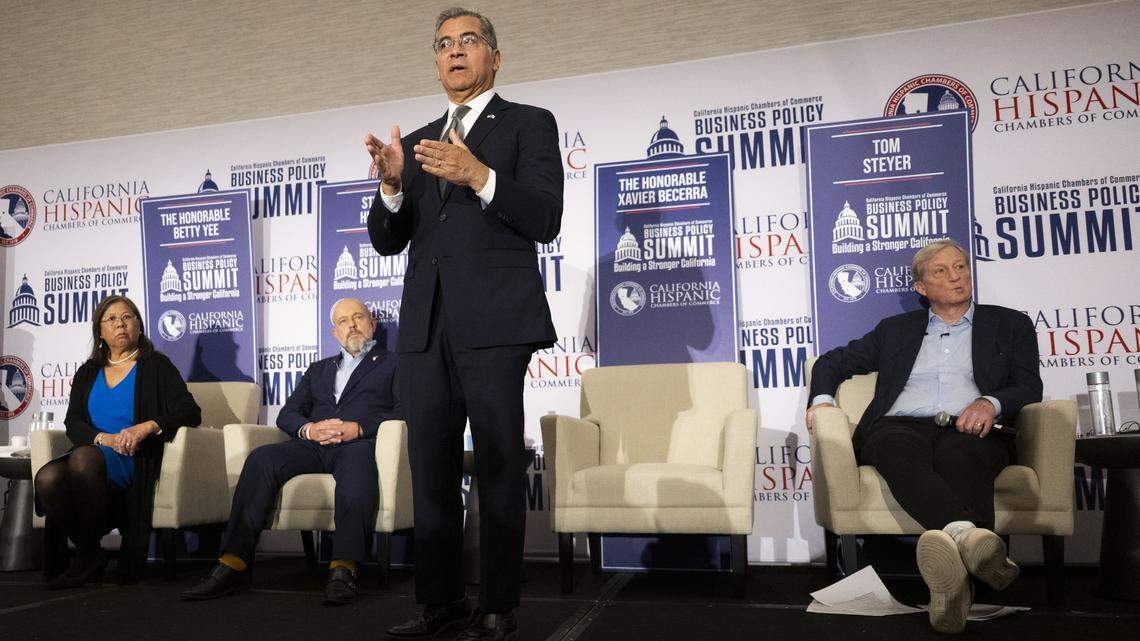
I moderated the first gubernatorial forum after sex abuse allegations ended the candidacy of former Rep. Eric Swalwell. Hosted by the California Hispanic Chamber of Commerce on April 14 in Sacramento, the event felt different. Not somber exactly, but recalibrated. The candidates on stage sensed it too. The oxygen that had been occupying Swalwell’s lane in the race was suddenly available, and everyone was trying to figure out who would breathe it in.
The early answer is Xavier Becerra.
An Emerson College survey last week showed him jumping from 3 percent in March to 10 percent now, the largest single gain of any candidate in the field. Two new polls released on Monday also showed enhanced support for Becerra.
Political operatives would call that momentum, even though none of their polling or models predicted it.
On Saturday afternoon I traveled to the Los Angeles Convention Center to see what the pundits were all missing. Becerra’s campaign had planned a rally expected to draw 200 supporters but by the time the doors opened, they had over 2,000 RSVPs.
There was a definite energy in the room.
Everyone was experiencing something real, not virtual. It was recognition. Relatability. This was a crowd that knew who Becerra was, not because they had ever met him, but because they said they could relate to him —and they showed up because of it.
What struck me most was that these were voters the Democratic establishment hasn’t been hearing. These were the blue collar voters Democrats have been losing. They had come from Boyle Heights, Azusa, Rialto, and Pomona. These were working-class voters who seemed genuinely relieved at the implosion of the establishment candidate because now they had a voice in a process. More people talked about Becerra having once been a construction worker in Sacramento than being a Stanford graduate.
This matters enormously for a party that cannot figure itself out on the eve of a primary election. Even as Becerra’s rally was underway, the back-channel pressure to consolidate the field was continuing. Party leaders, operatives, and donors were doing what they do best: trying to manage the outcome rather than let it breathe. The real danger for the Democratic Party is not a fractured primary. The danger is a party so focused on getting candidates out of the race that it has forgotten to let voters in.
What I saw at Becerra’s rally was something no pollster had modeled and no data expert had predicted. The coalition in that room was white suburbanites standing next to Latino immigrant rights activists standing next to African American small business owners and Asian activists. The multi-racial California working class. It defied every outdated sorting mechanism we use to poke at California politics, every crosstab, calculator and cluster analysis built on yesterday’s assumptions about who votes with whom and why.
The Democratic Party is in danger of becoming so data-driven that it has lost connection with real people. It’s algorithms over human beings. If Democratic operatives trying to winnow the field in the governor’s race would set the data aside for a moment and observe the people who turned out for Becerra, they might have seen what I saw: A struggling working-class base speaking clearly through the din of culture attacks, paid influencers and anti-Trump attacks.
It was as if the forgotten coalition of the party had finally stood up and said, enough. We have bowed to the privileged promises of this party for long enough. We have watched them pick the candidates, set the agenda, and define what it means to be a Democrat. And all it has gotten us is empty promises, failing systems and broken candidates.
What happened Saturday afternoon at the Los Angeles Convention Center was not a campaign rally. It was a declaration.
It is time Democrats realize the future of their party looks more like Becerra’s old neighborhood than Swalwell’s. If we’ve learned anything during the Donald Trump era it’s that strong parties don’t fear many voices - weak ones do.
Mike Madrid is a political analyst and a special correspondent for McClatchy Media.