
California has been in a megadrought for more than a decade, scientists say. When it will end?
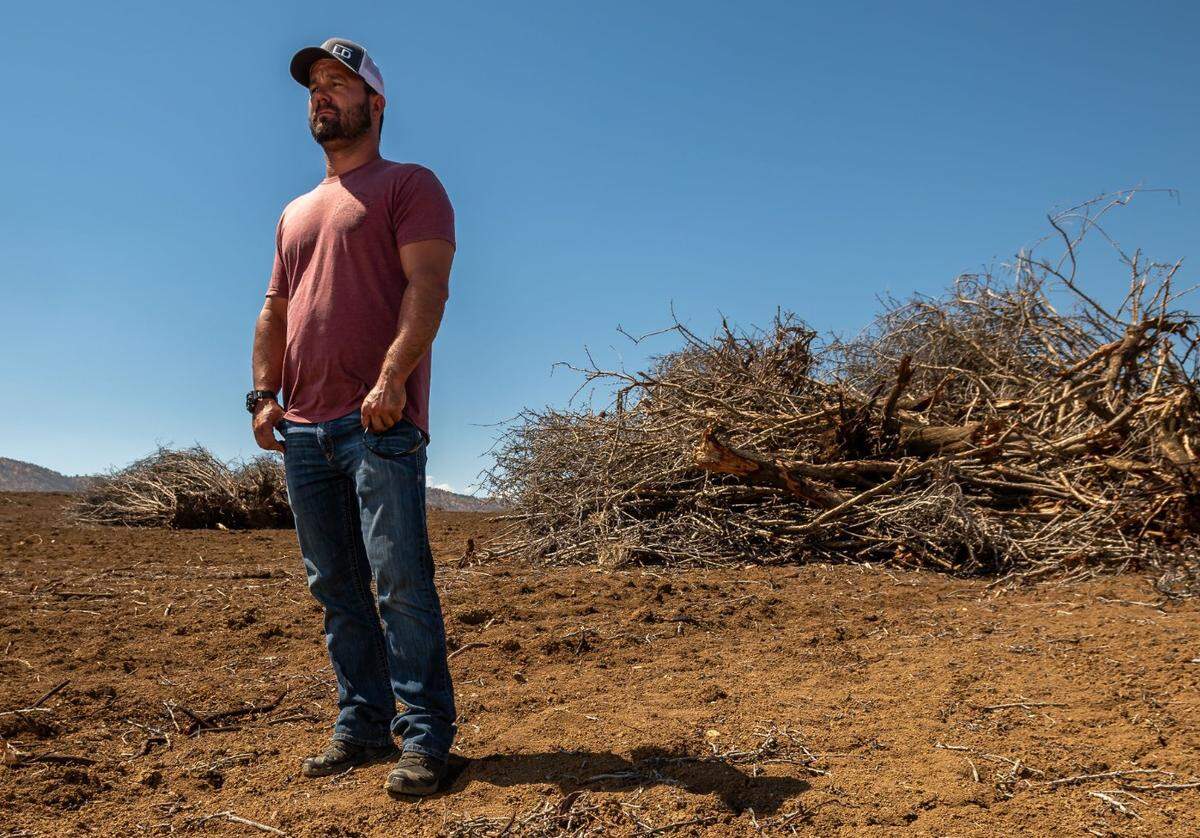
Once it was an almond orchard, planted at the beginning of a boom time in California agriculture. Now it’s just scattered clumps of dead limbs and branches, the remains of trees brought down by California’s drought.
Zach Dennis ripped up 527 acres of almond trees in May, laying waste to a portion of his farm near Maxwell in the utterly parched west side of the Sacramento Valley. He’s in the process of abandoning another 100-acre orchard, and wonders what new misery the drought will inflict.
“If this happens again next year, then what do we pull out?” Dennis said as he trudged through the remains of one of his orchards. “The hits just keep coming.”
The drought is just three years old, by official reckoning. But the reality is likely worse. Scientists believe California is suffering through a megadrought of a decade or longer — an extended crisis, interrupted by the occasional rainy winter, that ranks with the worst dry spells of the past 1,200 years.
It’s anyone’s guess when it will end.
“Are we going to see another 10 years of this or another 20 years of this?” said John Abatzoglou, a UC Merced climate expert. He said climate change “is increasing the likelihood that we’re going to be seeing longer droughts.”
That’s not all. Climate change appears to be driving California beyond droughts or megadroughts, into a condition that’s considerably worse: a permanent state of progressively hotter and drier weather.
“We’ve got this phenomenon of aridification, the drying of the American West,” said Wade Crowfoot, secretary of the California Natural Resources Agency.
The implications for water supplies are obvious. “The aridification that we’re experiencing leads us now — the science and the data leads us now — to understand we will lose 10% of our water supply by 2040, all things being equal,” Gov. Gavin Newsom said last week as he outlined a new drought blueprint aimed at fortifying supplies in the coming decades.
Aridification is already touching nearly every aspect of life in California. Great forests have become tinder boxes, as evidenced by the explosive growth of the McKinney Fire out of the Klamath National Forest along the California-Oregon border. Communities hundreds of miles from wildfires wind up breathing the smoke; the record wildfires of 2020 produced nearly twice as much carbon dioxide as all of California’s power plants combined.
Those power plants are struggling to keep up with the increasing demand for electricity as massive heat waves sock the West. The threat of blackouts, like those in August 2020, remain an ever-present summer reality. The drought is erasing the state’s precious hydro power supplies, as when the big generating station at Lake Oroville was forced to shut down last summer for the first time ever.
“We have to be redefining what we think of as a good year or a normal year,” said Park Williams, a UCLA climate scientist.
A hotter California means that when precipitation comes, it’s more likely to fall as rain instead of snow. That’s an increasingly nightmarish scenario for managers of a statewide water network built decades ago around the idea of dependable, bountiful snowfall. Rain is harder to store than snow, and the implications of that are already manifesting themselves.
The mightiest rivers and reservoirs don’t provide enough water anymore to support farming. Coupled with a state law curtailing groundwater pumping, California is on track to permanently idle 1 million acres of farmland in the largest agricultural-production state in the nation.
Ecological disasters loom: The shutdown of most rice farms in the Sacramento Valley this summer means a lot less food and habitat for millions of migrating geese, mallards and other waterfowl on the Pacific Flyway. Chinook salmon and other endangered fish cook themselves to death every summer in California’s overly-warm rivers.
Lush green lawns, a California birthright, are increasingly a thing of the past. The state has rules curtailing lawn sizes surrounding new homes. Thinking of heading to Lake Tahoe this winter? Snow is dwindling, and ski resorts are reinventing themselves for longer summers with bike paths and rock-climbing walls.
In the midst of all of this is the paradox of climate change: The future will be hot — but also intermittently, brutally wet.
Climate change is disrupting traditional weather patterns and creating “a shorter, sharper rainy season in California,” said UCLA climatologist Daniel Swain.
California experienced record precipitation in 2017 and the out-of-nowhere rainstorm that pelted Northern California last October. “That’s a serious concern in a warming climate,” Swain said. “When it rains it pours is literally the case when it comes to climate change.”
Drought ended in 2017. But not really
In April 2017, after torrential rainstorms caused flooding in parts of Northern California, Gov. Jerry Brown lifted the drought emergency he had imposed three years earlier. In his famously grumpy style, however, he warned Californians they’d need to continue conserving water.
“The next drought could be around the corner,” he said.
A year later he signed two bills nicknamed “Making water conservation a California way of life.” They require local water agencies to reduce customers’ indoor use to an average of 50 gallons a day, per person, by 2030. A new bill, pending in the Legislature, would reduce the target to 42 gallons.
As for that next drought, Brown was right. After a rainy 2019, dry conditions returned in 2020, and last summer Newsom declared a new emergency. The wet years merely “represented a little bit of a reprieve,” Abatzoglou said.
Abatzoglou was part of a team of researchers who produced an alarming report for the academic journal Science in 2020. They concluded that California and the West have been in an “emerging North American megadrought” since 2000. It’s the second-worst drought on record since the late 800s, eclipsed only by a nearly three-decade spell that ended in 1603.
“It’s very clear that the very wet year in 2019 didn’t come close to ending the drought,” said UCLA’s Williams, lead author of the study and a Folsom native.
Williams said when one drought ends and the next one begins really doesn’t matter. The crucial issue, he said, is that California is getting hotter and drier, and the rainy winters usually aren’t wet enough to overcome the effect of the worsening summers.
“The dry conditions have outweighed the wet conditions,” Williams said.
Climate change, wildfire and vanishing snow
Just to be clear: Climate change doesn’t cause droughts. It makes them worse.
Swain said California is getting, on average, roughly the same volume of precipitation as ever. But it’s getting more rain, less snow. A recent study in the journal Nature predicted “persistent low-to-no snow conditions” in the West in the coming decades.
That’s bad news for water supplies. California needs melted snow to replenish its system as summer arrives. In a decent year, the Sierra Nevada snowpack holds 17 million acre-feet of water, according to a study in San Francisco Estuary & Water Science. That’s 70% as much as Shasta, Folsom and all the other reservoirs combined. (An acre-foot is 326,000 gallons).
“We’re going to lose 75% of our snowpack in the future,” said Jim Peifer of the Sacramento Regional Water Authority, which coordinates supplies for the area. “We’re going to lose what I like to call our snow reservoir.”
Another problem: For reasons that aren’t completely understood, Swain said climate change is delaying the onset of California’s rainy season by about a month.
That effectively prolongs wildfire season, just as the soil and vegetation are getting good and baked. Little wonder that 10 of the 20 largest wildfires in California history have ignited in the past four years, according to Cal Fire. The Camp Fire — which killed 85 people, more than any other California wildfire — obliterated Paradise on a cold November morning in 2018.
As it gets hotter, everything in California gets thirstier — lawns, farm fields and more — and there isn’t enough water to go around. In that sense, the drought feeds on itself. “It takes a lot more for us to break out of a drought now,” Abatzoglou said.
Human activity intensifies drought’s consequences. Central Valley farmers pumped enough groundwater during the mid-2010s to fill Shasta Lake, the largest reservoir in California, seven times over. The relentless pumping caused parts of the Valley floor to sink by several feet — compressing the layers of sediment where groundwater sits. That’s effectively shrunk the storage capacity of some groundwater basins, making it far more difficult, if not impossible, for some aquifers to recover in wet years.
And when it does rain — well, look out.
Even though climate change delays the start of winter, Swain said the warmer atmosphere can store additional moisture. Winter is shorter but the storms are more intense. Swain calls the phenomenon a “whiplash effect” between extremes of drought and wet weather.
Which can bring flooding.
The state has spent $3.5 billion on flood safety in the Central Valley since 2007. Even so, a recent analysis by the Department of Water Resources said the hazards are intensifying because of global warming: “Communities throughout the Central Valley are threatened by the current and future effects of climate change on hydrology, such as increases in precipitation falling as rain instead of snow at higher elevations, extreme precipitation events fueled by atmospheric rivers, and runoff events that significantly exceed the State’s flood system design capacity.”
Bounded by two major rivers, Sacramento is one of the most flood-prone cities in America. Officials imposed a seven-year ban on construction in Natomas, ending in 2015, because of levee vulnerabilities. The area’s flood control agency has spent billions fortifying levees in the past 20 years and says more work is needed.
But around the capital region, most policymakers are concentrating instead on water shortages.
“It’s been kind of hard to get the Legislature and the governor to focus on this,” said Barry Nelson, who consults with environmental organizations on California water policy.
Can Sacramento capture more river flows?
Flood risks aside, the Sacramento region’s water agencies are on a mission to turn heavy storms into drought relief.
Near the northwest edge of Roseville, inside a nondescript building by the Fiddyment Farms subdivision, sits a municipal water well hooked to a maze of baby-blue pipes. It is part of an “aquifer storage recovery system” for taking water and storing it underground.
Traditional wells operate passively, allowing water to seep gently into the soil. This system is more aggressive. When the American River is gushing, a high-pressure pump grabs some of the water and dumps it into the well, injecting it into a vast groundwater basin hundreds of feet below, an aquifer that can hold twice as much water as Folsom Lake.
“In the wet years you try to capture that water,” said Trevor Joseph, a city of Roseville hydro-geologist.
Water officials say greater Sacramento needs more of these facilities. As climate change creates fewer opportunities to capture water, the Regional Water Authority is designing a $300 million “water bank.” The plan calls for installing roughly three-dozen additional aquifer storage systems around the region over the next decade or so.
When completed, the project will enable agencies to pull more water out of the ground during dry years — enough to supply as many as 90,000 households, according to Peifer, the authority’s executive director.
“We will need to build infrastructure,” Peifer said. “I don’t believe we can solely conserve our way out of adapting to climate change.”
Sacramento’s water supply is actually pretty good this year; it wasn’t a great winter but much of the state’s precipitation fell on the American River watershed. Folsom Lake, which holds about half the area’s water, is at nearly average depth for this time of year.
But in the drought year of 2014, Folsom almost dropped to “dead pool” status, at which lake levels would have been too low for its valves to deliver water to the 1 million residents who rely on the reservoir. Reservoir operators nearly had to install a floating pump on the lake to raise the lake’s water level.
Folsom fell to uncomfortably low levels last summer, too, although it wasn’t as bad as 2014, said Ryan Ojakian, the water authority’s legislative and regulatory affairs manager. That scary history has the Water Authority racing to build the water bank.
“The sense of urgency is, we can’t assume that Folsom will not go to dead pool,” Ojakian said.
Adjusting to a warming climate at Tahoe
It’s a 75-degree day in the Sierra Nevada, and camp is in session.
Kids are skateboarding, or kicking up dust on mountain bikes. If it weren’t for the chair lift in constant motion — retrofitted to haul the bikes up a steep slope — it’d be hard to tell that camp is being held at a ski resort.
Boreal Mountain and its Utah-based owner, Powdr, have jumped into summer recreation with the speed of an alpine racer. They’ve built skateboard parks and a rock-climbing wall. They’ve carved bike paths into the slopes usually reserved for skiing and snowboarding. They’ve installed a ninja warrior-themed obstacle course, called the Wrecktangle, in the parking lot.
The centerpiece is a 22,000-square-foot indoor gym, nicknamed “the bunker,” that provides skateboard and scooter tracks, foam pits for tumbling, and more. It is open year-round, even during ski season.
Whether “it’s going to snow or not, it gives us the opportunity to offer people something,” said Tucker Norred, the resort’s senior marketing manager. “This is something we can control; we can make sure we’re always open.”
Nobody in the ski business around Tahoe will forget 2015, when most resorts shut down for the season early because the snow was gone. Now they’re hustling to adapt.
That means expanding their artificial snow equipment to keep winter alive. It also means diversifying revenue streams — and hedging their climate bets — by investing in warm-weather activities.
Homewood Mountain, on Tahoe’s north shore, has purchased a marina to rent and sell boats. It holds craft fairs and archery tournaments. On the south shore, Heavenly offers rope courses, zip lines and “summer tubing,” which lets customers glide along a 500-foot carpet of artificial turf.
Perhaps no resort has pivoted to the new reality more aggressively than Boreal, with its indoor and outdoor facilities, weekly summer camps for kids and a “ladies’ night” for skateboarding. It recently hosted a two-day concert series that drew around 3,000 fans. Boreal is so determined to carve out a separate identity for its non-snow activities tha it’s even marketed under a different brand: Woodward.
Snow is still the big draw. Boreal greets about 130,000 skiers, snowboarders and tubers each winter, Norred said. The Woodward facilities draw about 35,000 customers a year, including wintertime use.
Norred wouldn’t say how much Boreal has spent on Woodward, but described it “a sizable investment in our future.”
Nathan Doty, a 10-year-old from Colfax, exemplifies the resort’s warm new world.
“I love how you get to go up ski lifts and ride down mountains,” he said after mountain-biking down Castle Peak ski slope.
Droughts have disrupted civilizations
Megadroughts aren’t new: A study led by Columbia University and NASA found that western North America has seen seven of them since 862, usually lasting “multiple decades.”
Other parts of the world have suffered, too, and some of these megadroughts have brought down entire societies.
“Over the last 12 centuries of human civilization, multidecadal megadroughts contributed to the demise of some of the most complex societies of the preindustrial era, including the Khmer and Mayan Empires, the Puebloan cliff dwellers of the southwestern United States, and the Yuan Dynasty of China,” Cornell University’s Toby Ault wrote in a 2020 article for the journal Science.
A drought that began in 1271 was a significant factor in forcing the Pueblo society to abandon the Four Corners region of the American Southwest, “where they survived quite nicely for about 700 years,” said Timothy Kohler, a Washington State University anthropologist.
Kohler said the Pueblos had withstood previous droughts. But by the time the 1270s arrived, they were already struggling with other problems, including an influx of foraging, nomadic tribal groups that competed for scarce food. Then the megadrought — which lasted 26 years — devastated the maize crop and pretty much rendered the area uninhabitable.
“We think it was mostly climate,” Kohler said. “Drought caused the depopulation.”
Could such a disaster happen in modern times? Koehler said just 90 years ago a severe drought across the Great Plains, accompanied by massive storms of windblown topsoil, prompted 2.5 million people to head west in one of the greatest migrations in American history.
“Think about the Dust Bowl,” Kohler said. “That certainly caused a lot of dislocation.”
California agriculture faces grim water future
Zach Dennis’ family runs a vertically integrated farming operation in Colusa County, on the west side of the Sacramento Valley — rice fields, almond and walnut orchards, processing plants and warehouses. In a good year, they support more than 100 permanent and seasonal jobs.
The drought has brought that empire to its knees. The family planted fewer than 300 acres of rice this year — out of 4,000. The walnut trees are doing OK, but a February cold snap wiped out the almond crop. Employment has been slashed.
“We are literally shutting down warehouses, downsizing employment, to get through this,” Dennis said.
Perhaps no sector of California life is facing greater trauma from aridification than the state’s $50 billion-a-year agricultural industry. UC Merced researchers calculated that the drought robbed the farm economy of $1.7 billion last year, and this year’s toll is likely to be worse.
Even a good soaking this winter won’t erase the long-term existential threat to California farming.
Decades of groundwater pumping left many Central Valley aquifers so badly depleted that portions of the Valley floor have sunk. The Legislature passed a law in 2014, the Sustainable Groundwater Management Act, that requires farmers to gradually but significantly reduce how much water they can extract.
The law doesn’t fully kick in until 2040, providing a decent glide path. But it’s clear that farming is going to shrink.
By how much, isn’t clear. A 2019 study by the Public Policy Institute of California said 700,000 acres of farmland could permanently disappear in the San Joaquin Valley, the state’s unofficial capital of agriculture. A year later economists from UC Berkeley put the figure at 1 million acres — about one-fifth of what’s currently in production.
Former Assemblyman Roger Dickinson, who co-authored the sustainable groundwater law, said the progressively higher predictions reflect a realization of how droughts work in California these days: Instead of inflicting their punishment quickly, they drag out the pain year after year.
“We underestimated it — they’re enduring, long-term conditions,” said Dickinson, now the policy director at Sacramento environmental nonprofit CivicWell. “It’s looking chronic.”
California almonds boomed. Then came the drought
Until a few years ago, almonds were the golden commodity of California agriculture.
Almond prices were so high that orchards exploded across the Central Valley, relegating tomatoes and cotton and other “annual” crops to the sidelines. But because trees have to be irrigated every year, environmentalists warned of a painful reckoning when water supplies ran short.
Which is exactly what has happened. The golden crop has become a symbol of what’s gone wrong in farming. Almond prices have fallen in half the past few years. Water has become so expensive that farmers are starting to rip out trees before their time.
Dennis’ farm doesn’t rely on wells so he doesn’t have to worry about the Sustainable Groundwater law. But supplies from the Sacramento River, delivered via canal, have become so miserly that he’s had to do the unthinkable.
This year Dennis has killed off more than half his almond trees, more than 600 acres — with no clear blueprint for what to do next with the land.
“We’re definitely not going to replant those trees right now,” Dennis said.
The orchards that have been cleared include trees planted a generation ago — the family’s initial foray into almonds.
“I remember putting them in, in 1998, as a freshman in college,” he said. “I was all excited, our first tree crop.”
Many of the trees were starting to lose productivity. Others, though, still had several years to go — and having to get rid of them prematurely is a major reason why Dennis is becoming increasingly pessimistic about farming.
“It’s becoming more difficult to get a sustainable water allocation,” he said. “The future of agriculture is scary. It keeps you up at night. This is all I’ve ever done, this is all I want to do. I’m not sure it’s going to be fine.”
This story was originally published August 17, 2022 at 5:00 AM.