Coronavirus updates: More vaccine doses head to California as ICU capacity dwindles
Even with hundreds of thousands of doses of a 95% effective vaccine expected to be distributed and administered, the next several weeks figure to be the worst of California’s coronavirus crisis.
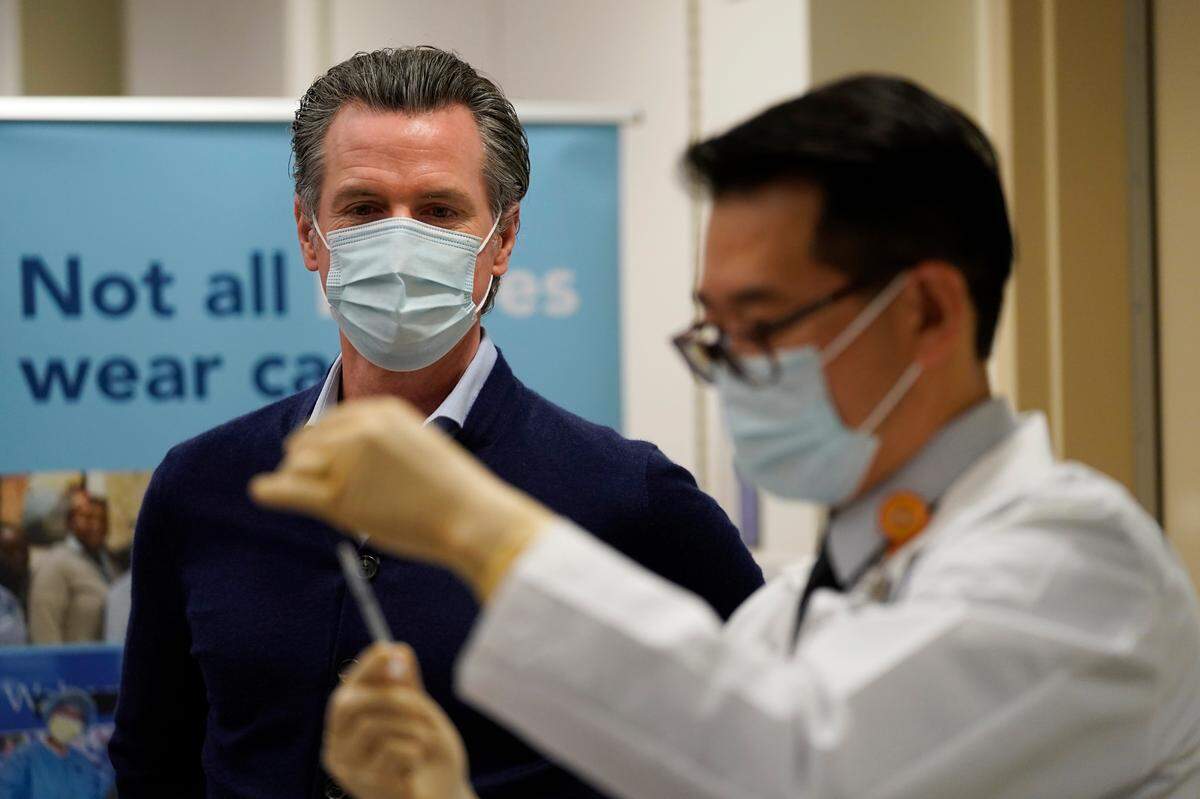
The vaccine developed by Pfizer with German biotech company BioNTech received emergency use authorization in the U.S. late last week, and the first shots in the nation were given Monday.
Distribution continued this week in California. Doses arrived Monday in Eureka, Los Angeles, San Diego and San Francisco. The remainder of the state’s first allocation of 327,000 shots was expected to arrive Tuesday and Wednesday, Gov. Gavin Newsom said.
Newsom announced Monday in a video posted to Twitter that California secured an additional 393,000 doses of Pfizer’s vaccine, set to arrive “early next week.”
In a state with 40 million people, these numbers still represent a limited supply. California has established the earliest available doses will go to front-line health care workers who deal directly with COVID-19 patients, followed by long-term care facilities such as skilled nursing homes, and then other to other essential workers.
Between Pfizer and Moderna — which could have its vaccine candidate approved before the end of the week — and other companies, Newsom has said California expects to receive a little over 2 million vaccine doses before the end of 2020.
Health officials are hopeful the vaccine is the beginning of the end of the pandemic, and that by distributing the earliest doses to the most at-risk populations, many lives can be saved.
But supply for at least the next couple of months will be too limited to put a dent in community transmission rates. The vaccine won’t begin to flatten the curve among the general population until doses can be administered in large numbers, which isn’t expected to happen until around spring at the earliest, depending on how smoothly the distribution process goes.
In other words, public health measures to rein in the spread of COVID-19 — mask use, social distancing, avoiding gatherings, etc. — are still of utmost importance as California weathers by far its worst surge in virus activity yet.
First vaccine doses arrive in Sacramento
UC Davis Medical Center, which has specialized freezers and is serving as a repository, received its first shipment of the Pfizer vaccine Tuesday morning, one day later than initially expected.
UC Davis Health at around 7:30 a.m. tweeted a photo of the dry-ice package arriving. UC officials say they will administer doses to critical care hospital workers immediately.
The Sacramento region expected to get an initial allotment of 35,145 doses this week, much of it likely Tuesday and Wednesday.
Newsom and the state have not yet provided a region-by-region breakdown of the 393,000 Pfizer doses the governor announced Monday as being inbound next week. If that batch is split at the same proportions as the first round of 327,000 doses, it would mean the Sacramento region would get about 42,000 more doses.
How bad is California’s surge? How low is ICU capacity?
The state’s surge of COVID-19 infections continues to balloon to new heights on almost a daily basis.
The rolling two-week average for cases has more than sextupled since the start of November, jumping from 4,200 to over 28,000. The statewide rate for tests returning positive has more than quadrupled, from 2.5% in mid-October to 10.6% as of Tuesday.
The hospital situation is bleak. Nearly one-fifth of all 74,000 licensed hospital beds in California were occupied by virus patients as of a Monday update from the California Department of Public Health.
Nearly 3,100 of those 13,635 hospitalized cases were in intensive care units, leaving fewer than 1,500 ICU beds available. The hospitalized virus total grew by a net of 648 patients between Monday and Tuesday, a new single-day record for the pandemic.
ICU availability was at 1.6% in the San Joaquin Valley region on Tuesday, after dropping to 0% two out of the previous three days. Southern California — home to more than 20 million people — dropped to a record-low 1.7%. The state as a whole reported having about 5% of its staffed ICU beds available Tuesday.
Virus deaths are sharply rising. The state reported a single-day record of 225 COVID-19 fatalities on Saturday and has now averaged 141 a day over the past two weeks. That’s just one shy of the peak during the summer surge, of 142, and up from 40 a little over a month ago.
In his grimmest remarks yet during the pandemic, Newsom announced Tuesday the state has ordered 5,000 body bags and 60 mortuary refrigeration units to prepare for the flood of coronavirus deaths expected in the coming weeks.
Newsom earlier this month announced a region-based stay-at-home order, which clumped counties into five regions drawn up based on mutual aid networks and places regions into a strict shutdown once ICU capacity falls below 15%. Southern California, San Joaquin Valley and the 13-county Greater Sacramento region have all entered the new restrictions. Greater Sacramento first dipped under 15% last Wednesday, and has fluctuated near that mark in the past week.
The stay-at-home order represents the strictest pandemic protocols instituted in the state since March. Restaurants must close for both indoor and outdoor dining, and barbershops, salons and other personal care services are required to join numerous entertainment-based non-essential businesses in shutting down.
The Bay Area, which has not yet fallen below 15% ICU availability but was at its lowest point of 15.8% on Tuesday, had five of its counties proactively enter tighter restrictions before the state directive kicked in. The region designated as Northern California, made up mostly of counties north of Greater Sacramento, still had close to 30% ICU space available as of Tuesday.
Sacramento County Health Officer Dr. Olivia Kasirye this week said she is hopeful the recent restrictions imposed on the 13-county Sacramento region will reduce the number of new infections while the inoculation program ramps up.
She called on people to be cautious during Christmas and New Years and avoid family gatherings
“We’re still putting out a plea to stay home and stay within your households so we get through this going in to the new year,” she said this week. “We have a light at the end of the tunnel with the vaccine coming.”
Test positivity leaps above 20% in 3 Greater Sacramento counties
The state on Tuesday provided a weekly update to the tier list, with health officials demoting Inyo County to purple from red.
With that, just three counties combining for about 20,000 residents — Alpine and Mariposa in red, Sierra in orange — are in tiers other than purple, the most restrictive level. All three of those are subject to the regional order, which supersedes the tier system.
In other words, more than 99.95% of California by population is in the purple tier, and the entire state is either in the purple tier, the regional stay-at-home order or both.
CDPH also on Tuesday released the latest data for test rate positivity and new cases per 100,000 residents across all counties. The numbers come from the week ending Dec. 5, which is the full calendar week after Thanksgiving.
The news remains particularly bad for the Sacramento region: Of all 58 counties in California, three of the 13 in Greater Sacramento had the worst, second-worst and fourth-worst positivity rates statewide. Colusa soared to 25%, Sutter was at 24% and Yuba was at 20%. Sutter County had the state’s highest per-capita case rate at 98 per 100,000 residents.
San Bernardino joined those three as the only counties above 20%, which is quadruple the rate recommended by the World Health Organization for economic reopening to proceed.
The center of the capital region — Sacramento, El Dorado, Placer and Yolo counties — were all clustered near the middle of the pack for the 58 counties. Yolo’s rate was at just over 11%, and the remaining three were all between 12% and 13%.
Nevada County’s rate was 11%. The other moderately populous foothills counties of Amador, Butte and Plumas ranged from 7.5% to 9%. Tiny Alpine and Sierra counties had among the state’s lowest positivity rates at 2.9% and 1.3%, respectively.
Spread of the virus has shown clear signs of acceleration all throughout the region: Test positivity increased compared to the previous week in every county except Alpine and Sierra. Colusa’s test positivity rate jumped by nearly 10%, and Amador went up by 4%. The other nine counties’ rates grew anywhere from around 1% to 3%.
Amazon not complying with subpoenas, attorney general says
Amazon has not informed the state of how many of its workers have been infected with or died from the coronavirus, California Attorney General Xavier Becerra said in a petition filed in Sacramento Superior Court on Monday.
Becerra is asking the court to order Amazon to comply with subpoenas that were filed months ago.
In a statement, Amazon said it has been working cooperatively with the Attorney General’s office.
High school sports on hold at least until late January
High school sports in California will not start before Jan. 25, according to the updated youth sports guidelines posted to the state’s Department of Public Health website on Monday night.
As long as the guidelines do not cancel or eliminate sports, there remains hope for the 815,000 or so student-athletes in the state who have been on hold. Many of those teenagers have done distance learning since the coronavirus pandemic shuttered schools in March. Area student-athletes have been vocal about their frustrations of not playing, citing a mental toll.
It has been nearly five months since the governing body California Interscholastic Federation laid out its 2020-21 sports calendar after a summer of the virus surge, a process that required updates and guidance from health departments.
No school-based sporting events have played out in California this fall, though club sports such as soccer, softball and baseball included out-of-state tournaments, now put on hold with the updated guidelines. Club football has also seen interest, including a Sacramento effort to get a team into a Southern California league next month.
Sacramento-area numbers: Nearly 950 virus deaths
Coronavirus activity across the six-county Sacramento area continues to grow exponentially. Over 79,000 residents have tested positive and at least 949 have died of the virus since the start of the health crisis.
Thousands of those infections are still considered active, several hundred are hospitalized and dozens are in intensive care units across Sacramento, El Dorado, Placer, Sutter, Yolo and Yuba counties.
Sacramento County has reported a total of 51,052 infections and 699 related deaths since the start of the pandemic, adding 829 cases and increasing the death toll by 10 on Tuesday. The county reported 2,750 new cases and 19 fatalities Monday for a period including the weekend.
State data on Tuesday showed 473 coronavirus patients in Sacramento County hospitals, expanding on the all-time record set Monday by 10. The total includes 90 in intensive care, one below the record high from summer.
The county maintained 86 ICU beds, up by seven compared to Monday, as hospitals work to expand surge capacity.
Local health officials have now confirmed at least 130 virus deaths from November. The month has surpassed September’s toll and is now second only to August, when 181 county residents died of the disease.
County health officials have also confirmed 38 deaths for the first 10 days of December, as of Tuesday’s update. Based on preliminary numbers and current hospitalization trends, December’s death toll appears likely to exceed November’s.
The county’s latest estimate is that of the 51,000 cases, close to 14,000 are still currently active. That’s a little less than 1% of Sacramento County’s population.
The city of Sacramento has recorded 388 virus deaths and nearly 28,000 cases. The latter mark equates to about one in 18 capital city residents having tested positive for the disease.
Placer County health officials have reported a total of 9,722 infections and 94 deaths, updated Tuesday with 173 additional cases and one new fatality. The county reported one death Monday and three last Friday.
Placer County on its local dashboard reported 179 patients hospitalized with COVID-19 including 22 in intensive care. State data updated Tuesday showed 184 hospitalized with 23 in ICUs.
The state and local hospital dashboards showed Placer with zero ICU beds remaining available, down from seven the previous day. The county page updated Monday said seven available ICU beds was equal to 10% capacity.
The reason for the sudden drop was not immediately clear, but county health director and interim health officer Dr. Robert Oldham told the Board of Supervisors during Tuesday’s meeting that the ICU capacity metric can vary widely day-to-day and “does not take into account other beds that can be used for critical care during a surge.”
“So while this is a very serious situation, we want to reassure the public that our hospitals have robust surge plans, are constantly adjusting and can still take care of people,” he said.
Yolo County has reported a total of 6,377 infections and 98 deaths. The county added 110 new cases and nine fatalities Tuesday, the latter a one-day record.
State data updated Tuesday showed Yolo with 26 virus patients in hospital beds including 14 in intensive care, with five ICU beds still available.
Yolo’s own dashboard showed 32 currently hospitalized, with 14 still in ICUs.
El Dorado County has reported 4,198 positive test results and eight deaths. The county reported 113 new cases Tuesday after adding 331 on Monday in a report which covers the weekend.
The state on Tuesday reported 29 people hospitalized in El Dorado, a record. Eight were in ICUs, down from 14 one day earlier. Seven ICU beds are available.
In Sutter County, 5,051 people have been infected and 37 have died. Sutter on Monday reported 394 new cases and four virus deaths for the period including the weekend. County health officials also reported two deaths last Friday and one on Thursday.
Neighboring Yuba County has reported 2,990 infections and 13 dead, adding 170 cases and three fatalities between Friday and Monday’s updates.
The bi-county health office dashboard on Monday showed 50 Sutter residents hospitalized with 12 in ICUs, plus 12 Yuba residents hospitalized with three in ICUs.
Not all of those 62 are necessarily hospitalized in-county. The lone hospital in the Yuba-Sutter region, Adventist-Rideout, had 61 patients hospitalized with 13 in ICUs and three ICU beds remaining available, according to Tuesday’s update from the state.
This story was originally published December 15, 2020 at 8:45 AM.