
‘It’s Tracey; remember me?’ The path from homeless in Sacramento back to the ‘real world’
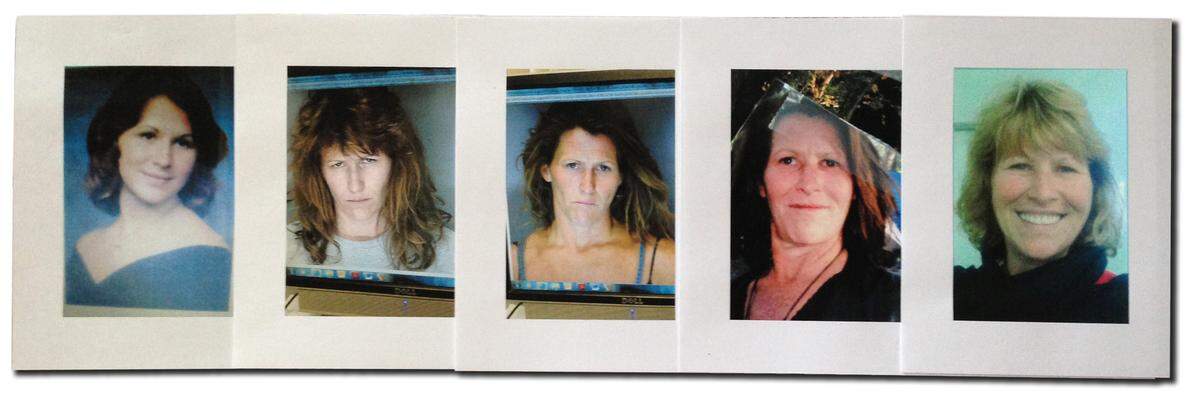
Tracey Knickerbocker likes to show people five photos of herself: First, there she is, in her 1979 graduation picture, lovely in a slightly off-the-shoulder blue dress as a senior at Fairfield’s Vanden High School. Her hair is curled and her smile is unsure, maybe, but hopeful.
In the second one, a Sacramento County Sheriff’s Department mugshot taken exactly 20 years later, she’s unrecognizable, though unmistakably furious after her first drug arrest. “I was all rage,” she says, looking at her scowling 1999 self.
By the time of her next mugshot, in 2005, her face is thinner and her expression vacant. She’s not mad anymore, but “look at how sucked up I am, pathetic and sad.” In 2008, the year she got clean, we can see that the pilot light is back on. “That’s when I discovered food.” And in the final frame, taken right after she became a homeowner in 2014, she is grinning.
After 21 years of meth use and a full decade of homelessness, she believes that God kept her alive to do what she’s doing now, at age 61, as a case manager for Hope Cooperative.
She sees her homeless outreach work as really just offering some compassion — an ear, a bottle of water, a hug if they’re open to it — to people who are today where she was for an awfully long time. She knows the power of empathy, because it’s what slowly brought her back to what people living on the street call the real world: “People just kept coming back, being kind, and poking holes in my hardened heart.”
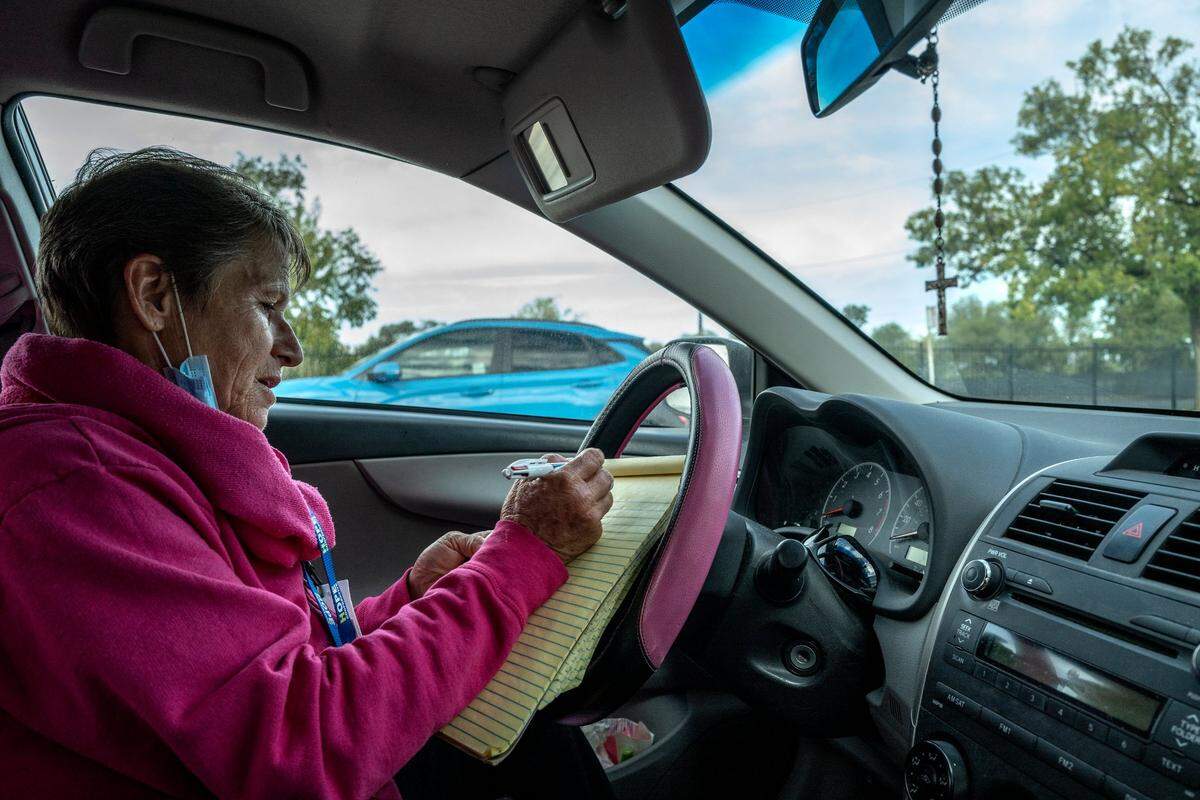
Riding with Tracey as she makes her rounds, you get a tour of Sacramento that does not include Sutter’s Fort or the state Capitol: There, on Richards Boulevard, is “the McDonald’s where I could wash my hair and dry it with brown paper towels before they could stop me.” There’s the 12th Street bridge she lived under for a few years. And there’s the saddest landmark of all, near the Arden Garden overpass, where after she’d gotten sober and was riding her bike home from a meeting, she found an older homeless gentleman who had been hit by a car still lying in the street, unable to get up because both of his legs were broken.
She had just called 911 when a carload of teenage boys pulled up. “I thought they were going to help,” but instead they took video. Newton was the man’s name, and Newton, if you are out there, Tracey has never stopped praying that you are OK.
Quadriplegic in a tent
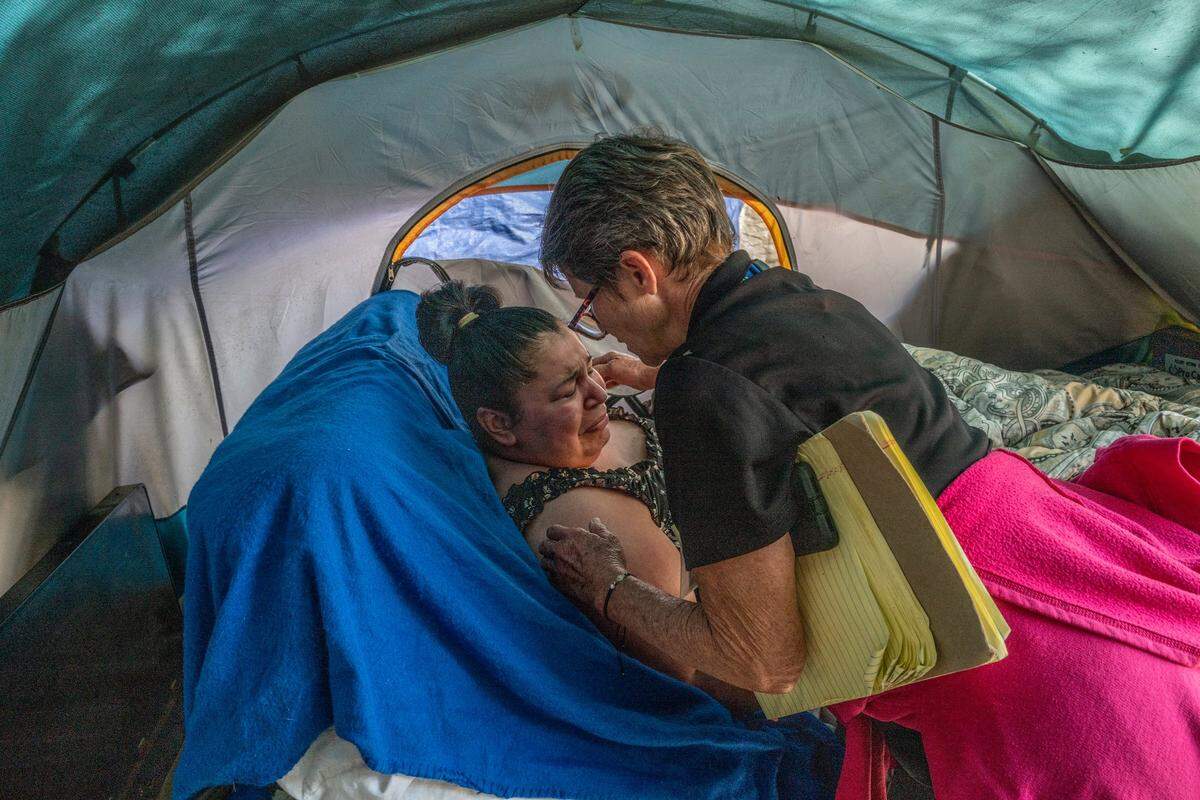
Her first stop of the day is to check on Holly Porter, who is “functionally quadriplegic,” — she can lift her arms just a little — and is living in a tent because her application for Social Security Insurance has repeatedly been denied.
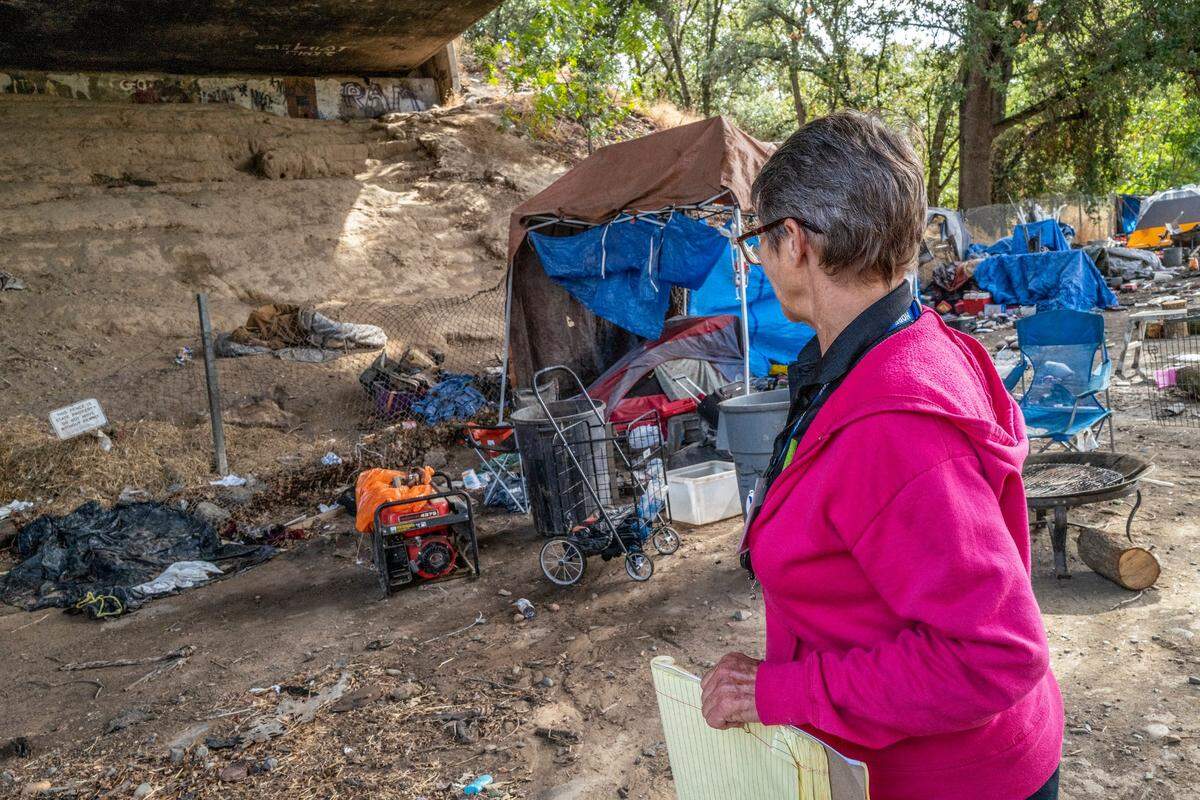
The encampment where Holly stays, down a path near the intersection of Arden Way and Colfax Street, “has lots of drug activity,” Tracey says as we walk past abandoned mattresses, tires and people. “It’s Tracey; remember me?” she calls to a woman stirring scrambled eggs over a fire.
Two women were shot here recently, in separate incidents, and noise from yet another fight has kept Holly from sleeping the night before. So her mother, who lives in the tent next door and cleans houses to support them, because that’s work she can do without having to leave Holly alone for too long, asks us to come back later.
When we do, Holly is where she always is, in her electric hospital bed powered by a generator that runs on gas, which runs Holly and her mom about $400 a month.
This is a big day, though. Holly has just heard from the attorney Tracey found for her that there’s been a decision on her latest application for disability. What that decision is, she doesn’t know.
“We’re going to stay hopeful,” Tracey tells her.
Right now, you may be wondering how someone who can’t move enough to shoo away the flies in her tent could possibly have been turned down, not once but four times.
But four of five claimants are denied when they first apply, and homeless applicants are often denied for technical reasons, such as failure to receive or return the forms on time. Maybe since we hear so much about cheaters, we assume no qualified applicant could ever wind up being rejected, though the level of actual disability fraud has consistently been under 1%.
The cause of 40-year-old Holly’s disability is somewhat unclear because she started to lose mobility years ago. At first, doctors thought she might have multiple sclerosis, but ruled that out.
Then, when she was eight months pregnant in 2020, she suffered a uterine inversion — a rare, potentially fatal complication in which the uterus turns inside out during childbirth. By the time she arrived at the hospital, she was in active labor but had already lost the baby, and became septic. Almost a month later, coming out of an induced coma at Sutter Medical Center, “I woke up not able to move and in the most pain I’ve ever been in in my life. I couldn’t even be touched.”
‘I try not to say anything’
Holly and her husband are “kind of on a break now,” but after she was released from the hospital, he stopped working to take care of her. Then they lost their housing and ran through their savings paying for motel rooms. She was briefly admitted to a nursing home, but “I couldn’t handle it. They left me in a soiled diaper for a whole day.”
Gregg Fishman, spokesman for the city’s Department of Community Response, said she would not have been eligible for a motel voucher because, to get one of those, you must be able to take care of your own physical needs.
Holly also has congestive heart failure as a result of the sepsis. Doctors “gave me five years to live, and I want to spend it with my family,” she says, and starts to cry.
Tracey hasn’t heard this part of her story before. “Gosh darn it, Holly, I’m so sorry,” she says quietly. “Can I give you a hug? I’m so glad you told me.”
“I try not to say anything,” Holly answers, and cries harder. “The loss of my son took its toll,” she says a minute later, even if “I’m not really one to talk about my problems.”
.JPG "SAC_RCB_20220920_HOMELESSTracie0492 (1).JPG")
Tracey tries to get her to think about where she might like to live if her application is approved, but Holly can’t seem to allow herself to do that.
“I’m a ‘hope for the best, expect the worst’ type person,” she says. “Just trying to make it through the day,” with the help of her mom, her dog Felicia, who sleeps on her lap every night, and her books, especially the historical romances she likes best. While we’re talking, her husband drops off some flowers he’s brought her, but doesn’t come in.
“I’ve had every law enforcement officer there is tell me I shouldn’t be out here, and something should be done,” she says. “They all take my information,” and then are never heard from again. “You’re the only one who’s actually been constant,” she tells Tracey at the end of their visit. “It’s nice to have someone in your corner.”
“You’ve helped me learn a lot, too,” Tracey answers.
“What a survivor,” Tracey says as we walk back to the car. She should know.
Hell and back in 21 years
As the daughter of a decorated Air Force jet fighter pilot, Tracey’s upbringing was solidly middle class. She moved all over with her family, spending long stretches in Thailand and in Italy. She earned a bachelor’s degree in criminal justice, and at 26 was still living with her parents in Arizona. Then, in 1987, “I came here to visit my sister, met a man, picked up and packed up” and soon “discovered meth and cocaine.”
At first, “I was a weekend warrior, still doing my nails and hair,” and never missing work as the manager of a group home for sex offenders. But there were some serious problems at that home, and after she became a whistleblower, “I had a total breakdown, became agoraphobic” and now that she wasn’t working thought, “OK, this gives me more time to use. Heavily. What I didn’t realize was that the meth was making me sicker mentally.”
She started hoarding, and let her home fill up with boxes inside more boxes. “The encampments you see out here? My house looked like that. I was paranoid about my mail, so I’d shred it and pour syrup on it.”
Still, “I didn’t think I was an addict,” because she didn’t use a needle — that came later — and because she knew how to make her meth last by dividing it into little “power pellets.” She had so many of those on her at the time of her 1999 arrest that they charged her with sales.
“I’d never been to jail,” which was “degrading and humiliating. They have you bend over and cough.” Tracey shared a cell with a pregnant woman on her way to prison in connection with some gang activity and listened to that woman talk about “all the mistakes she’d made, and now she has this baby coming. I just laid there and listened.”
Released a week later while awaiting trial, where could she go? She’d already been evicted and had been living in her car, and she couldn’t go back to her dealer’s house if she wanted to stay out of jail. Finally, Sister Libby Fernandez, who was running the homeless nonprofit Loaves & Fishes then, told her she could live in her car in the parking lot while doing a street-sweeping job.
To avoid the 10 years she’d have to serve if convicted, she stayed clean for the six months she spent there.
But the minute the charges against her were dropped, because the deputies who’d arrested her had tried to improve their case against her with statements that went beyond the facts, she told her supervisor that she was taking a leave of absence to go get high. She’d be back, she told him, just as soon as she’d “had a belly full.” She kept that promise, but it took nine years.
What happened? Drugs
By the morning after Tracey’s first night on the river, across the bike bridge from the homeless encampment known as “The Snake Pit,” she’d already had all of her stuff stolen. So she was crying, furious, and had not even started to get her belly full when she met Jeff Fry, her best friend still, and someone who is still living on the river. “He’ll probably die out there.”
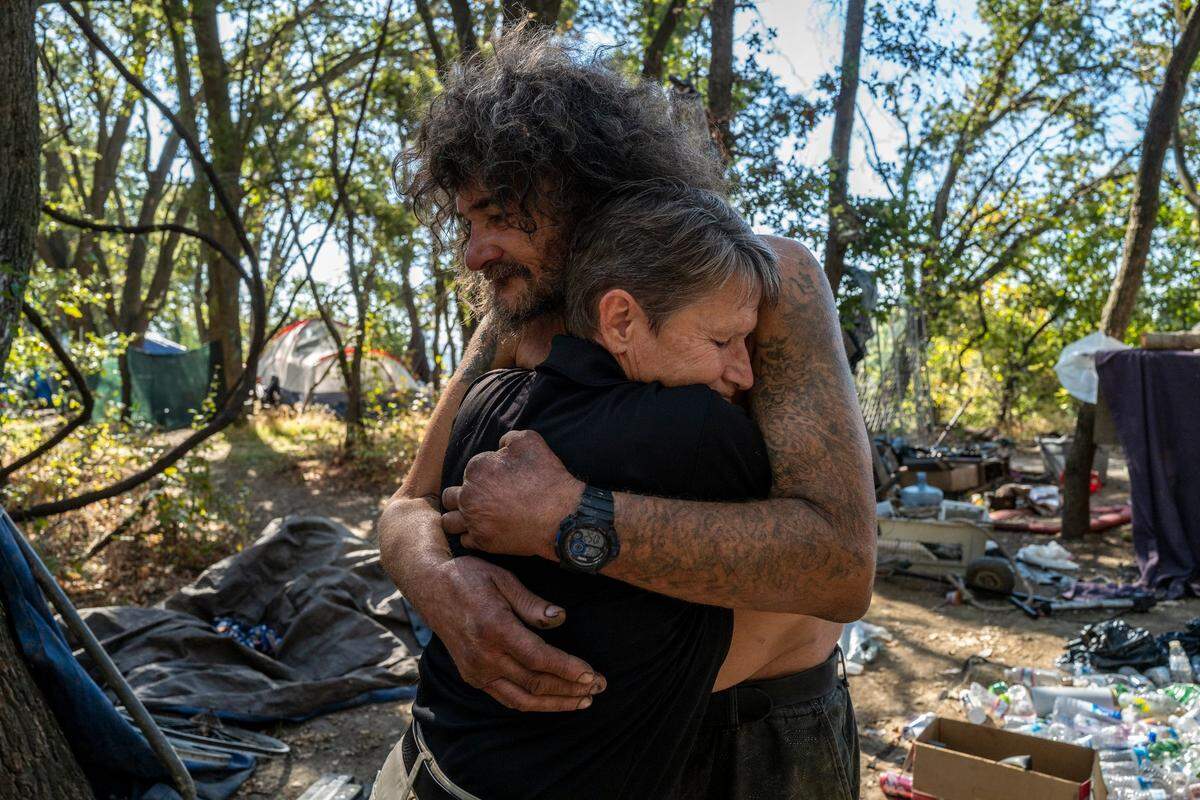
We’re on our way to visit Jeff on “The Island,” across from Discovery Park, the encampment where she lived for a few years, too, when he comes racing across the street toward us on his bike, laughing and shouting, “I know that walk!”
Back “when she used to do drugs, she could do more than anyone I ever knew,” he tells me. But he’s more impressed that after eight-and-a-half years as a daily IV drug user, she didn’t just get clean, but even stopped smoking cigarettes. “God, Tracey, you made that seem so easy.”
Jeff, who is 61, too, has been homeless most of his adult life, ever since his ex-wife won full custody of their two daughters. “I used to say that I’d stay alive ’til I saw them, but now I don’t know. I can’t deal with it,” and so tries not to think about it.
He’s not only fended for himself out here, but has tattooed himself, and when necessary, pulled his own teeth. Like a lot of homeless people, “I used to work quite a bit” — construction jobs, mostly — but doesn’t any more. “I don’t know what happened.”
Tracey does know, and says so: “Drugs!”
“Man, Tracey,” he answers, “I love you.”
He says he’s down to using maybe once a week, and “I think I have an ulcer” from worrying about what will happen when the county forces him and the others off the island. He also worries about what will happen when he can’t take care of himself any more.
They talk about some of what they’ve survived and remember an acquaintance who was beaten to death a dozen years ago now. The attack was not really out of nowhere, since the guy had always been hard to take. But, Jeff says, “some of us knew how bad he’d been abused,” and so “let him get away with stuff.”
If people in the real world “would interact with us a bit more,” he tells me, “they’d understand better” that just like that man, “Red-haired Steve,” whose real name was Lloyd Steven Hancock, everybody out here has a story.
Before going off in their different directions, Jeff tells Tracey to say “hey” to some mutual friends in the police department, and she asks him to tell everyone on the island that she says “hi,” too. As always, after their goodbyes, Tracey wonders if this will turn out to have been the last time she ever saw him.
After being homeless, lights ‘too weird’
Of course, it was not as easy as it looked for Tracey to follow the breadcrumbs back out of the forest.
At her angriest, she says, she spent hours every day ripping the leaves off trees. “You’ve seen those people who don’t make sense screaming and yelling? I’d tear trees down on the American River Parkway — how is that OK? — and dig massive holes for no purpose. Nobody messed with me and my rage.” Her street name was “Wing Nut, because I was so crazy out of my mind.”
Still, Sister Libby and others never stopped reaching out to her, even though, as Libby now says, Tracey “was at the point you couldn’t even understand her.”
She really just started hanging around the Alcoholics Anonymous and Narcotics Anonymous meetings at Loaves & Fishes for the coffee and leftover doughnuts. But over time, she saw the people who went to those meetings changing, and saw her friends on meth dying.
“Most people I was out there with had died — overdoses, drownings, fluke shootings. I went out there to use and to die, and then I realized I didn’t want to die a homeless death,” as if she’d never existed at all, she says, overwhelmed for a minute.
Finally, one night, “I got down on my knees and said, ‘I’m done.’ I said, ‘Please, oh God, help me,’ and in the morning, I could feel a shift.”
For the first 18 months she was clean, she was still living in a tent.
Coming inside was a process, as is often the case. Initially, that only happened because she was bitten by a feral cat and wound up in the ICU. After she was released from the hospital, “I had a bed, boom,” thanks to the Salvation Army. But “after 10 years living in the bushes like an animal,” coming back to “normal” life was scary: “The abnormal had become normal.”
“People say they want housing, and they do, but it has to come with case management because it’s a culture shock. I had a fear of going inside.” Everyone living outside has experienced some serious trauma in the real world, Tracey says, and that’s why people so often “don’t want to go back.”
Even after she moved into permanent supportive housing, she couldn’t bring herself to use electric lights, because “it was too weird and seemed like too much light.” Instead, she kept using her flashlight at night. She didn’t use the microwave or the refrigerator, either, and wore all black, because “that was easy to keep clean. Separating colors was too complicated.”
A lot of formerly homeless people find they need to sleep in a tent inside their new homes for a time, though that didn’t happen to Tracey. Some have a hard time getting used to indoor plumbing. Toilets that flush automatically panicked Tracey at first.
Helping homeless neighbors
In 2010, she started volunteering for Sister Libby and at several local food banks, and also began facilitating Narcotics Anonymous meetings at the Sacramento County Jail and Folsom State Prison. Finally, in 2015, 22 years after she’d last held a full-time job, she went to work helping homeless people.
It had taken that long in her recovery, she says, for there to have been “a shift in my shame.” It took that long for her to feel “Yeah, let an employer ask me” where I’ve been. For her to be able to say to herself, “Yes, I made a mess of my life, but look what I’m doing now.”
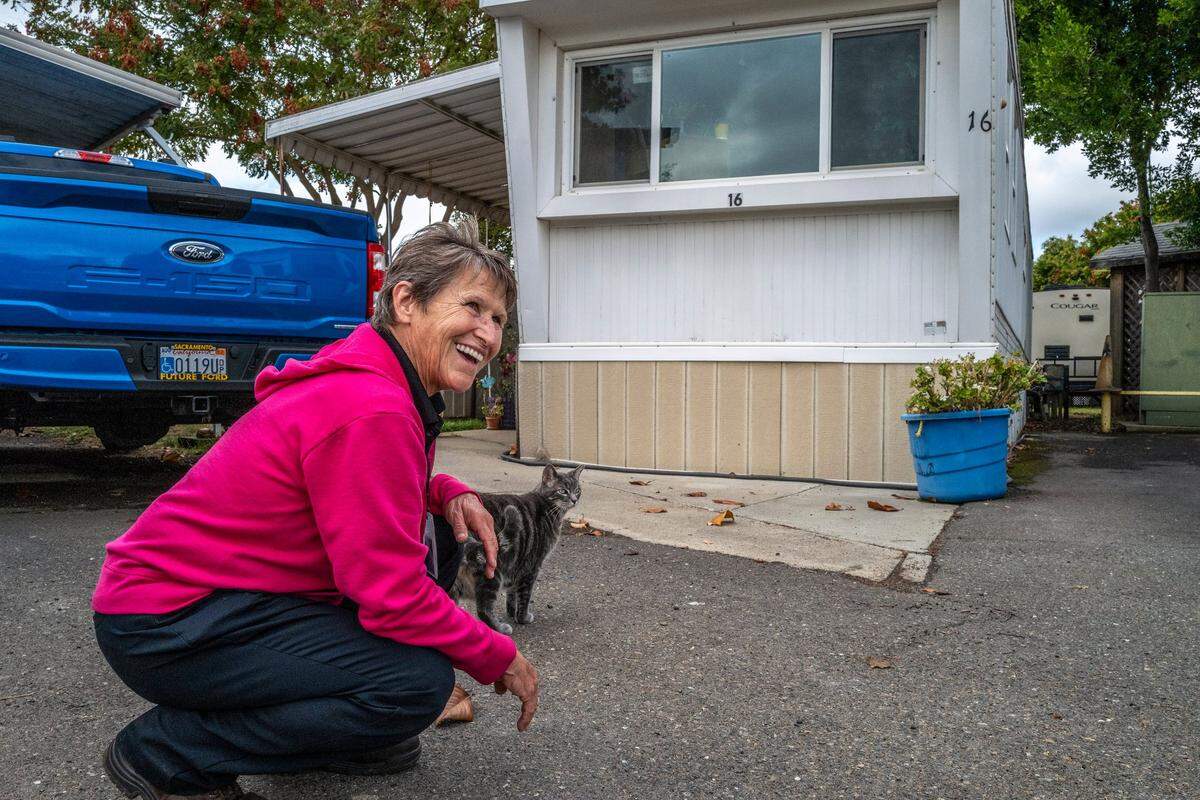
For a while, she did her outreach on a bike, but she has her own car now, and lives in a fixer-upper mobile home she bought for $2,000.
She joined the Catholic Church in 2018, and these days, says Sister Libby, “she inspires me. We text each other on holy days.”
As of April 2, Tracey had been clean and sober for 14 years.
“Most people out there do use,” she says, “and some people are addicts, and they hate it.” The new meth is stronger and more dangerous than when she was on it, and makes people “more violent, maybe. I’m seeing that. It’s an evil drug.”
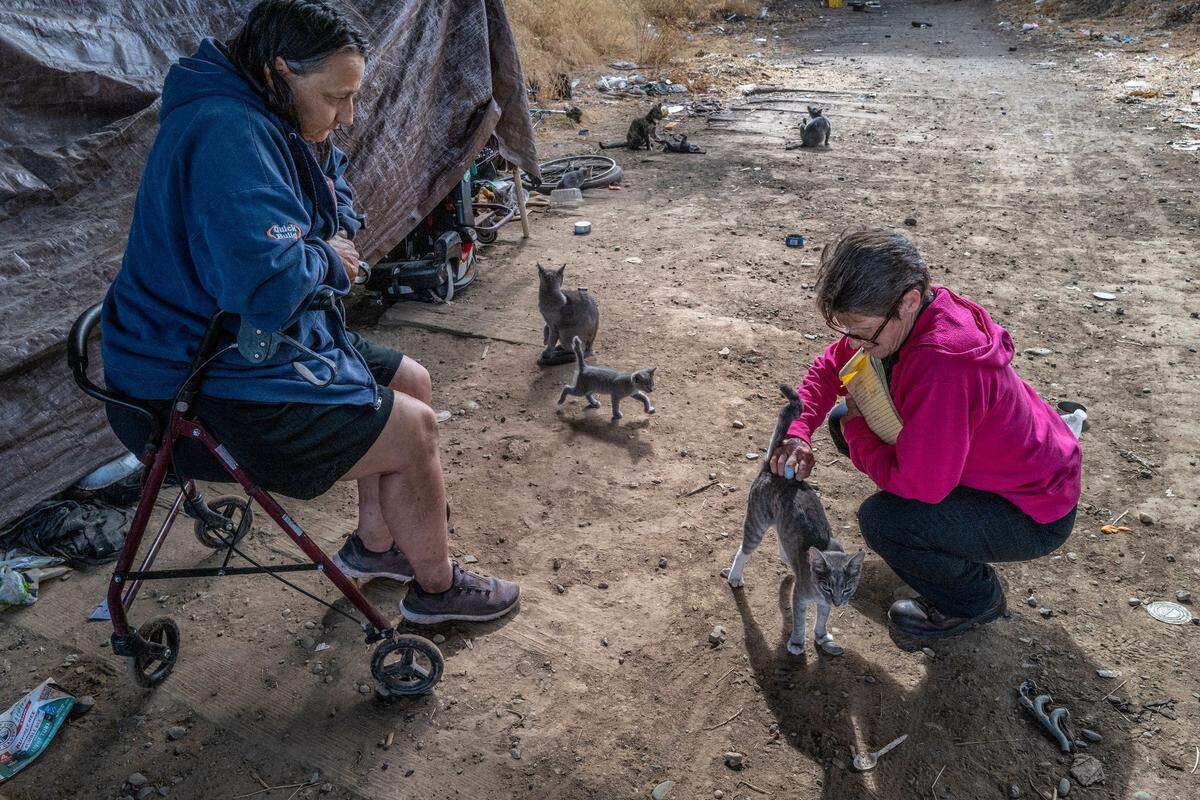
On Tracey’s rounds, she makes several appointments with new clients she hopes to help get some services. One man she’s been working with for some time will only speak to her through the canvas of his tent. But as long as he’s trapped inside by addiction, she’ll keep coming back, she says, hoping to spur some forward movement.
“Great news,” Tracey texts me the day after we visit Holly. Yes, her latest disability application has been approved. “This never should have been denied in the first place,” says Holly’s lawyer, Elizabeth Gade.
Holly had not appealed her latest denial in a timely way, so her new lawyer had helped her start the application process over from the beginning. There’s no record of why she’d been turned down, only that she was rejected in 2015, 2018 and in both October and December of 2021.
Most of her paperwork has been lost in flooding, Holly says, though what Elizabeth noted in her original interview with Holly was that she’d said Social Security had in the latest denial acknowledged that she was unable to move but said she should still be able to work.
“My guess is they were technical denials,” says Elizabeth, who has been working as a disability lawyer, and working with homeless clients, for 28 years. “They don’t have good addresses, don’t get the paperwork or appeal on time. What happens to people in homeless situations is they keep applying and never get anywhere through the system,” which is “very difficult to navigate.”
Holly was on her way to being denied yet again, because she’d never received the request for her “function reports” from various doctors. But by regularly checking on the status of her application, her lawyer was able to get the forms to her and address that problem in time. What’s unusual, Elizabeth says, is not that Holly’s application was denied before, but that it’s been approved now: “This was an amazing success story.”
It’s one that would not have ended well if Tracey had not connected Holly with a disability lawyer. When the check finally arrives, she’ll start receiving $1,040.21 a month. There will be two fewer homeless people in Sacramento when that happens, Holly’s mother says.
Holly herself is not so sure about that, since what she’ll get every month still won’t be enough to cover rent. Will she end up back on every housing waiting list in town? Or will she at last get the chance to live “anywhere that’s not here. I’m not picky.” These worries are real, Tracey says, but are also an expression of the fear that every homeless person feels as he or she prepares to come inside. “I think she’s scared. It’s a lot.”
We’re scared, too, when we walk past an encampment or see someone in pain on the street; this whole problem is a lot. But Tracey believes, because she has seen it and lived it, that we can help our homeless neighbors be less afraid, and can even help some of them rejoin the world, just by getting to know them.
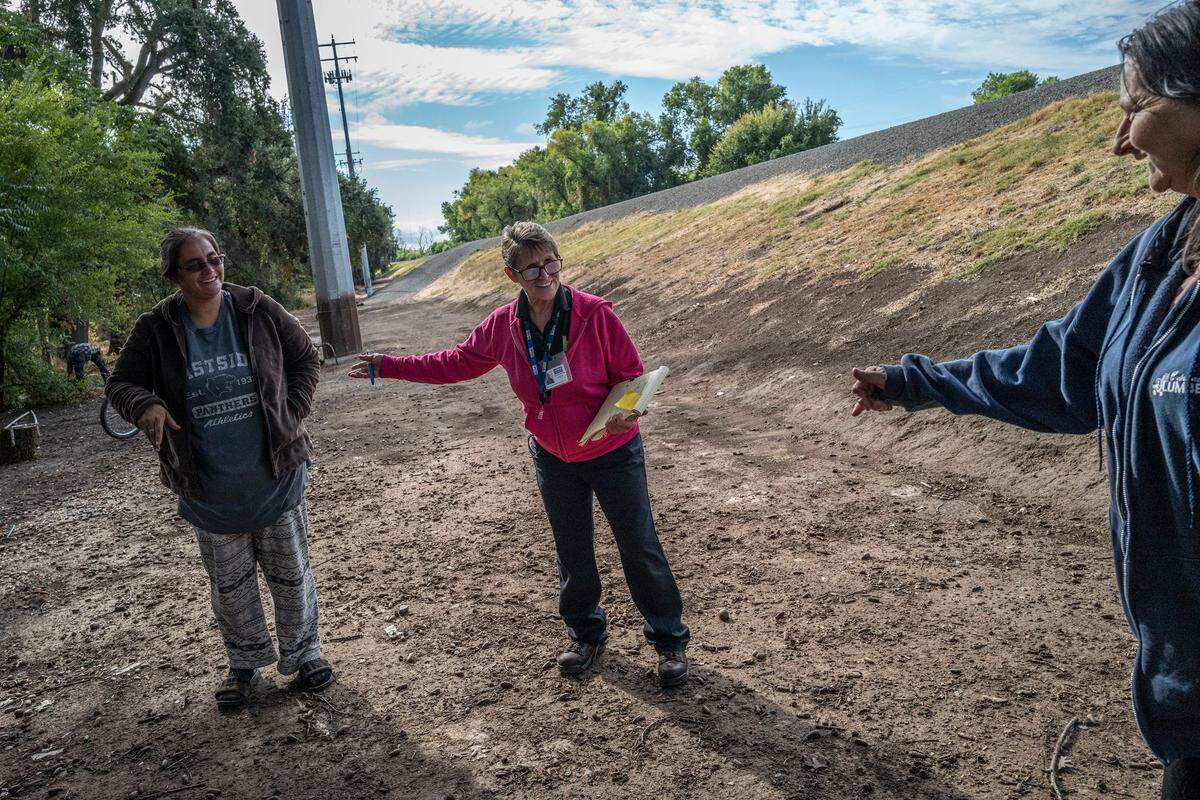
Start a conversation, she urges. Never give money, but always have a bottle of water or a pair of clean socks to hand out. What does that change? “Now they’ve got a little bit more self worth, because someone from the real world showed them a moment of kindness.”
Not only is Tracey Knickerbocker fighting homelessness one person at a time, but she is going so far as to suggest that maybe we can, too.
This story was originally published October 16, 2022 at 5:00 AM.