
To treat homelessness, Sacramento mayor wants a right to housing law. Why it needs support
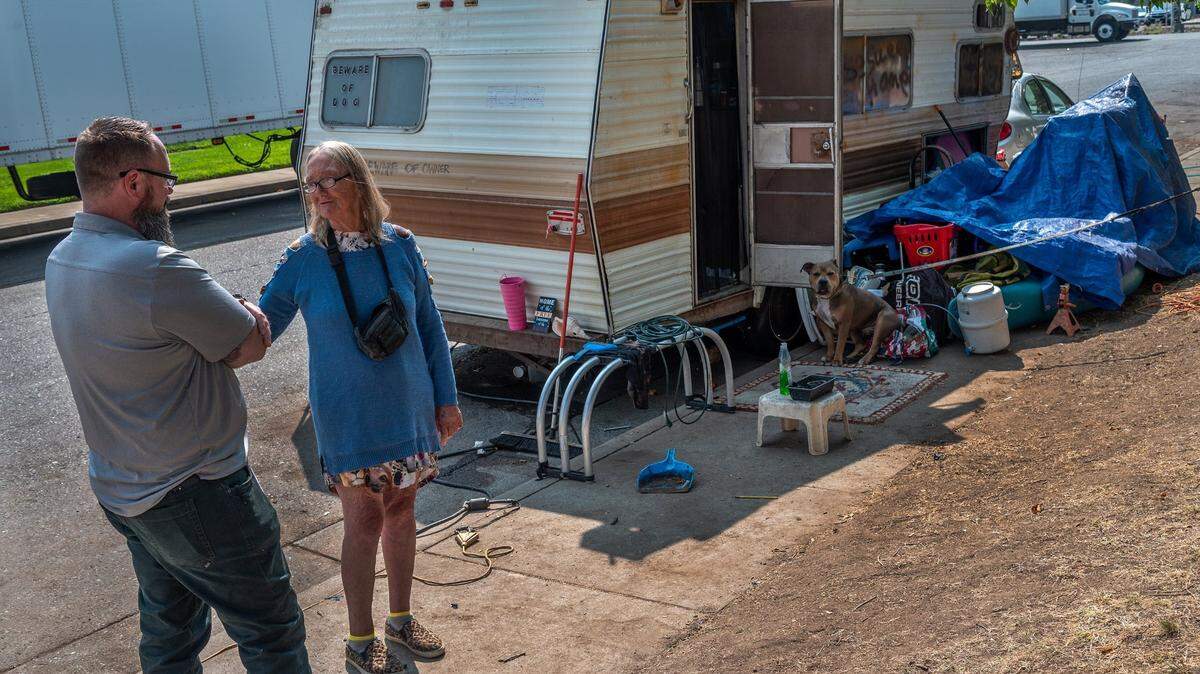
For years, Sacramento’s ability to adequately address the homelessness crisis has been plagued by insufficient policies and warring political agendas that made meaningful action almost impossible. In the absence of such action, the unhoused population has grown rapidly, their hardship and suffering persisting to sometimes fatal ends.
Residents and business owners have experienced greater danger to public safety and unsanitary conditions in their daily lives as a result. Our precious natural environment, most notably along the American River, has been marred by pollution and waste and regularly set aflame.
Sacramento Mayor Darrell Steinberg has staked his entire agenda on this issue and will be judged by the city’s ability to confront it. On Tuesday, the city council will take its first look at his proposal to enact a right to housing and an obligation to accept it, a two-pronged policy that would force the city to build enough shelter and housing capacity to compel the unhoused population to go indoors. In a practical sense, it also builds on Sacramento’s $100 million comprehensive siting plan, which city officials say could annually move over 9,000 people off the streets with a combination of safe camping and parking sites, tiny homes, motels and scattered housing units.
If effective, it could set a new national standard for governments facing this humanitarian crisis.
Steinberg’s right-to-housing law would give city officials a more humane alternative to the Martin v. Boise judicial precedent, which has prevented camp evictions from public spaces when there is no shelter readily available. In Sacramento and much of the rest of California, a chronic lack of shelter and housing has resulted in fewer sweeps.
By creating an obligation to accept shelter when it is offered, Steinberg wants to establish a system in which the city’s Department of Community Response workers, not police, are offering each unhoused resident two viable options for shelter.
This is also where the practicality and effectiveness of the law will be tested. While most of the estimated 11,000 unsheltered residents are likely to accept shelter, the proposal does not impose criminal and civil penalties on those who do not. Given the realities of many in the unhoused community, who have spent years sleeping outside wary of any arm of government, merely obligating acceptance creates the potential pitfall of city officials simply moving people from one place to the next.
The proposal also lacks clarity on how the city will be held accountable for complying with the right to housing. Steinberg told The Bee’s editorial board that “a court can force us to comply.” But legal action is expensive and often inconclusive. With human lives directly affected by this policy, there must be greater accountability in place to ensure this law is reaching its intended outcome and not causing further harm.
Sacramento cannot do this alone, either. County government, as the lead on health and human services in our region, needs to play a significant role and partner in the implementation of this policy. That falls on the Board of Supervisors to further legislate its role in addressing the crisis, and the county’s new chief executive, Ann Edwards, to put it into action.
If it’s adopted, Steinberg hopes the right to housing law, slated to take effect on Jan. 1, 2023, creates momentum for neighboring communities to do their part to end homelessness.
One of the conclusions last year of Gov. Gavin Newsom’s homelessness solutions advisory team, which included Steinberg and other elected officials from throughout California, was that the state should enact a right to housing. The Newsom administration must heed that directive and recognize that funding alone is not enough to combat this crisis.
The entire Sacramento community must rally around this ordinance because citywide participation in shaping it will only make it stronger. A law with this design, creating local policy that builds on this year’s homelessness plan, is our best chance to start seriously improving the lives of the unhoused community as well as our own.
Everyone in Sacramento deserves a home. Steinberg’s attempt to realize that deserves broad support and scrutiny to ensure Sacramento finally experiences relief from one of the most complex problems we face.
BEHIND THE STORY
MOREWhat are editorials, and who writes them?
Editorials represent the collective opinion of The Sacramento Bee Editorial Board.
They do not reflect the individual opinions of board members or the views of Bee reporters in the news section. Bee reporters do not participate in editorial board deliberations or weigh in on board decisions. The same rules apply to our sister publications, The Modesto Bee, Fresno Bee, Merced Sun-Star and San Luis Obispo Tribune.
In Sacramento, our board includes Bee Executive Editor Colleen McCain Nelson, McClatchy California Opinion Editor Marcos Breton, opinion writers Robin Epley, Tom Philp, LeBron Antonio Hill and op-ed editor Hannah Holzer.
In Fresno and Merced, the board includes Central Valley Executive Editor Don Blount, Senior Editor Christopher Kirkpatrick, Opinion Editor Juan Esparza Loera, and opinion writer Tad Weber.
In Modesto, the board includes Senior Editor Carlos Virgen and in San Luis Obispo, it includes Opinion Editor Stephanie Finucane.
We base our opinions on reporting by our colleagues in the news section, and our own reporting and interviews. Our members attend public meetings, call people and follow-up on story ideas from readers just as news reporters do. Unlike objective reporters, we share our judgments and state clearly what we think should happen based on our knowledge.
Read more by clicking the arrow in the upper right.
Tell us what you think
You may or may not agree with our perspective. We believe disagreement is healthy and necessary for a functioning democracy. If you would like to share your own views on events important to the Sacramento region, you may write a letter to the editor (150 words or less) using this form, or email an op-ed (650-750 words) to opinion@sacbee.com. Due to a high volume of submissions, we are not able to publish everything we receive.
Support The Sacramento Bee
These conversations are important for our community. Keep the conversation going by supporting The Sacramento Bee. Subscribe here.
This story was originally published November 15, 2021 at 3:14 PM.